Wednesday, March 27, 2019

That Time a Video Game had an Economy Almost as Strong as Russia

In late 2001 an economist called Edward Castronova made tsunami sized waves in the world of economics when he published a paper claiming that an isolated place called Norrath had a currency stronger than that of the Japanese Yen- an especially bold claim considering Norrath had less than a million inhabitants, had only existed for about two years and didn’t exist physically. Yes, Norrath was entirely virtual and populated exclusively by players of the video game EverQuest.

Released in 1999, EverQuest is an immensely popular and influential massively multiplayer online role playing gaming (MMORPG). Set in the magical fantasy world of Narroth and boasting an impressive (for the time) near half million subscribers at the apex of its success, EverQuest came to the attention of Castronova at first much in the same way it came to the attention of anyone- he just thought it sounded like a fun game to play.

However, as he became more familiar with the game, he noticed some rather fascinating things about how the virtual economy had developed within the game. This all culminated in him publishing on the Social Science Research Network a humorous but excellently researched, and ultimately groundbreaking, paper titled, Virtual Worlds: A First-Hand Account of Market and Society on the Cyberian Frontier. By his own admission, Castronova stated, “I thought maybe seventy-five people would read it and that’d be great.”

Instead, it quickly received over 16,000 downloads (and today is sitting at closer to 50,000). While this might not seem like much, let’s remember context here- this was an academic paper published on an online academic journal. Needless to say, that number of downloads made it the most downloaded paper in the history of the Social Science Research Network, which at the time featured almost 50,000 academic papers, including many dozens written by Nobel laureates.

Why was this paper so fascinating to the world of economics? As economist Yanis Varoufakis noted, “Economic theory has come to a dead end — the last real breakthroughs were in the 1960s. But that’s not because we stopped being clever. We came up against a hard barrier. The future is going to be in experimentation and simulation — and video game communities give us a chance to do all that.”

What Castronova had stumbled upon was essentially an economist’s dream- virtual worlds the researchers could use to analyze in a scientific manner various concepts in their field using large data sets and real people populating those worlds. Or as Washington Post journalist Brad Plumer succinctly stated, in virtual worlds, “The data is richer. And it’s easier to run economy-wide experiments in a video game — experiments that, for obvious reasons, can’t be run on countries.”

In short, economists in academia were intrigued with Castronova’s paper and its implications for future research.

So what did Castronova find? After painstakingly pouring over the available data surrounding the world of Norrath, he was shocked to discover that in real world dollars Norrath had the 77th highest GNP per capita, placing it squarely between Russia and Bulgaria at the time.

How was this possible for a virtual world with only virtual currency?

At the height of EverQuest’s popularity, sale of in-game items ran rampant and at one point in time a player could pretty much buy anything they wanted in-game, regardless of how rare or powerful it was, so long as they could flash the cash to make it happen.

Although Sony, who published the game, would make several attempts to quash this practice, claiming amongst other things that all of the items for sale were their intellectual property, as well as outright banning players they caught doing this, the sale of in-game items and avatars became a thriving industry on sites like Ebay.

In fact, former child actor Brock Pierce (perhaps best known as a kid for his roles in Mighty Ducks and First Kid, and as an adult for his work in crypto currency) even started a surprisingly successful company, Internet Gaming Entertainment Ltd (IGE), which dealt in these virtual goods in exchange for real money. The company maintained a rather large staff of low-waged workers who worked in Norrath and the real world, doing things like meeting to exchange goods, as well as building up avatars and acquiring virtual goods for future sale.

In any event, Castronova analysed over 600 illicit sales outside the realm of Norrath on sites like Ebay and then simply compared this to the value of the item in-game in the principle currency of Norrath- Platinum Pieces.

When he did this, Castronova discovered that the relative value of a single Platinum Piece compared to the US Dollar was $0.01072. While this may not seem all that much, as Castronova pointed out, at the time, “its value exceeds that of the Japanese Yen and the Italian Lira.”

With this value in hand, Castronova was then able to roughly calculate a number of other interesting things about the economy of Norrath. For example, it turned out the average citizen of Norrath earned around $3.42 per hour (or about $5 an hour today) when taking into account the value of the items and in-game currency they could realistically acquire during normal play per hour on average.

Combining this with the estimated time extreme players sunk into the game (according to data gleaned by Castronova in surveying over three thousands players), Castronova calculated:

Many users spend upwards of 80 hours per week in Norrath, hours of time input that are not unheard of in Earth professions. In 80 hours, at the average wage, the typical user generates Norrathian cash and goods worth $273.60. In a month, that would be over $1,000, in a year over $12,000. The poverty line for a single person in the United States is $8,794.

Looking at players of every time commitment level, Castronova determined that, despite the game being extremely new, the average player of EverQuest already had over $3,000 worth of sellable goods locked up in the game.

But we’re not done yet because Castronova was then able to roughly calculate the gross national product of Norrath based on the value of the (entirely virtual) goods it produced in 2001. His final number? About $135 million.

While, again, this may not sound like much, divided amongst the estimated total number of Norrath denizens, that meant the GNP per capita of the virtual kingdom was $2,266- a figure that, as previously mentioned, theoretically ranked the computerised state the 77th highest on Earth at the time.

Naturally, this information peaked the interest of Castronova’s fellow economists, as did other observations he made about the virtual world and economy he was studying.

For example, according to Castronova one of the more curious things he noticed during his research was that, despite every effort being made by Sony to give everyone an equal footing when the game began, financial inequality was quickly rife amongst the denizens of Norrath.

Additionally Castronova also observed how, much like in the real world, the wealthiest players would often hoard their wealth and use their vast resources to pay poorer characters to do all of the pointless busy work they didn’t want to waste time with, in effect becoming pseudo-employers who kept the lion’s share of any profits made via the work of the plebeians to themselves.

Anecdotally, Castronova would say of his own time in-game as a low level player with no resources: “My problem is that I am under-equipped. I have been basically naked, carrying only a simple club, a caveman in a world of cavaliers. My poverty is oppressive – no amount of rat fur is sufficient to buy even a simple tunic at the ludicrously high prices of the merchant biots.”

Naturally, as the game evolved, the whole “initial equality” thing also died off for some, thanks to those markets where players who had disposable income in the physical world could simply buy whatever they wanted for real money and enter the game vastly more powerful and capable than a player without this option.

Since Castronova’s paper, and partially as a direct result of his work studying virtual economies, the one time self professed “academic failure” and “schmo at a state school” managed to leverage this to level up in real life- securing a tenured position at Indiana University Bloomington as a professor of Telecommunication and Cognitive Science, as well as coming to be known as the “founder of the field of virtual economics”.

And as many other virtual worlds with complex virtual economies have likewise sprung up, economists and other scientists continue to study them, as they make great petri dishes to observe how various variables result in changes in economy and human behavior.

Going the other way, gaming companies like Valve have taken to hiring economists to help them manage their virtual worlds. As economist Robert Bloomfield notes, “If you’re creating a game with 100,000 users, with things that they can buy and sell, you need an economist just to help you tweak that system so that it doesn’t spin out of control.”

As for Castronova, he concluded his ground breaking paper by waxing poetic about the potential virtual worlds could have with the application of new technology, stating

The impact on Earth society is hard to overestimate. With the development of voice technology, communication in Virtual Worlds will move from cumbersome chat to telephone-like conversation, thus greatly enhancing the Virtual World as a place of social interaction. Families living thousands of miles apart will meet every day for a few hours in the evening, gathering their avatars around the virtual kitchen table and catching up. And the day of driving to the store may well be over. Earth roads will be empty because, instead of using them, everyone will be sailing across the azure heavens on their flying purple horses, to shimmering virtual Walmarts in the sky.

If you liked this article, you might also enjoy our new popular podcast, The BrainFood Show (iTunes, Spotify, Google Play Music, Feed), as well as:

Bonus Facts:

  • To trade items they’d bought illegally via Ebay and the like, Castronova observed that players would generally sell the item online first and then agree to meet in a designated place in-game, at which point the seller would then trade the item to the buyer for an item of trivial value they had in their possession. Castronova was amused to learn that, much like in real life, many of these illicit trades took place in abandoned buildings and dark alleys.
  • In 2017, the value of Venezuelan bolivar sank so low that it was quite literally worth half that of the principal currency of Azeroth, the kingdom the game World of Warcraft takes place in.
Expand for References

The post That Time a Video Game had an Economy Almost as Strong as Russia appeared first on Today I Found Out.


from Today I Found Out
by Karl Smallwood - March 27, 2019 at 04:39AM
Article provided by the producers of one of our Favorite YouTube Channels!
-

Moo Free Chocolates expands its range


Moo Free Chocolates has expanded its ‘marvellously moreish’ premium range with six new 80g vegan chocolate bars.

The family-owned chocolatier’s new additions include Sea Salt & Caramel, Sea Salt & Lime, Original and Cinder Toffee, a larger variant of their most popular smaller bar – the Mini Moos Bunnycomb bar.

“This is one of the greatest innovations in Moo Free’s history”, said co-founder Mike Jessop. “These are the premium chocolate bars consumers have been waiting for. Six new bars with bold, exciting flavours made with premium inclusions and ethically-sourced ingredients”.

The chocolatier also makes its debut in dark chocolate with a Dark 65 and a Dark 85 bar – both made with single origin cocoa mass.

“The fruity flavours of the single origin Dominican cocoa mass really come through with our brand new dark bars” said Jessop. “Our bars are also guaranteed to be vegan and free from dairy, gluten and soya as we don’t have those allergens in the factory.”

The demand for Moo Free’s vegan chocolates has grown rapidly since its founding in 2010 with their chocolates now available in UK retailers including Sainsbury’s, UK independents, and in over 38 countries.

The post Moo Free Chocolates expands its range appeared first on Sweets & Savoury Snacks World.


from Sweets & Savoury Snacks World
by Katherine Skeates March 27, 2019 at 02:37AM

Tuesday, March 26, 2019

EcchiTenshi is helping make eggrolls… That’s one is...


EcchiTenshi is helping make eggrolls… That’s one is a rong eggroll!
https://ift.tt/2HI2i5m
March 26, 2019 at 04:06PM


via Tumblr https://ift.tt/2Yv1QN1

Review: Freska! Choco Bar


This bar had a notably different look from any other candy bars or wafer bars we've tried, with a pyramid-like shape, perhaps playing off its Egyptian origin. ...

from Taquitos.net Snack Reviews
by March 26, 2019 at 02:13PM

Review: Sprouts Potato Co Kettle Style Chips Sea Salt Flavor Number 1


These potato chips had wiggly shapes and a strong yellow color, with lots of smallish bubbles embedded inside and some skin around the edges. ...

from Taquitos.net Snack Reviews
by March 26, 2019 at 09:02AM

Review: 7 Select Kettle Potato Chips Smoked Gouda


These potato chips had a golden yellow color and wiggly shapes, with nothing resembling seasoning powder that we could see. ...

from Taquitos.net Snack Reviews
by March 26, 2019 at 08:38AM

Rowntree’s re-brand sees four new additions to Randoms range


Brand new variants of Rowntree’s Randoms – Nestlé’s randomly shaped, fruit flavoured sweets – are being introduced to coincide with its tenth birthday and a major refresh of the Rowntree’s brand.

Sharing bags containing only Squish’ems (squishy foam and fruity jelly in one sweet), Foamies (foamy sweets) and sour sweets, Randoms Sours, are joining the existing range of Rowntree’s Randoms. A fourth sharing bag, Randoms Easter mix, is a seasonal selection of random Easter related shapes on sale now for the Easter season.

Rowntree’s Randoms are jelly sweets in a variety of random shapes and with six fruity flavours of raspberry, cherry, blackcurrant, orange, lime and ice cream.

The latest new shapes come courtesy of a Nestlé employee who has worked for the firm for almost three decades and will carefully hand carve the mould for each new sweet before it is taken to mass production. There are over 100 shapes, in 4 different textures and 6 different flavours which means there are billions of possible combinations of shapes for each pack and the chances of getting the same mix twice is mind-bogglingly unlikely.

In addition to the new shapes, the green sweets, currently lime-flavoured, will now be apple-flavoured after the change proved more popular in testing.

Hannah Smithson, assistant brand manager for Rowntree’s said: “We are so excited to announce all of this news for Rowntree’s Randoms’. There is truly something for everyone in the new range whether you prefer the jelly Squish’ems, the foamy sweets or something a little more on the sour side.

“We’ve been working very hard to make this year the best yet for Randoms and are delighted to introduce new shapes, tastes, textures and flavours that all our consumers will absolutely love.”


The introduction of new choices in the Rowntree’s Randoms range comes at the same time as a major re-brand for Rowntree’s which covers Nestlé’s full range of sugar sweets including Fruit Pastilles, Fruit Gums and Jelly Tots as well as Randoms.

The re-brand introduces brighter colours and more prominent branding across all packs while the Rowntree’s logo itself has a modern new-look with a darker green colour and updated font.


Alongside the new Rowntree’s Randoms products, Nestlé will say goodbye to Tooty Frooties, the chewy sweets with a hard shell that date back to the 1960s.

A Nestlé spokesperson said: “Sweet tastes and trends change over the years and Tooty Frooties have become much less popular in the decades since their launch. In 2019, people prefer the jelly and foamy sweets you find in Rowntree’s Randoms and that’s why we’ve decided to concentrate on new products under the Randoms brand.”

The post Rowntree’s re-brand sees four new additions to Randoms range appeared first on Sweets & Savoury Snacks World.


from Sweets & Savoury Snacks World
by Katherine Skeates March 26, 2019 at 07:34AM

Darling Spuds expands crisp range


Independent crisp brand Darling Spuds has launched new flavours and packaging as it prepares to mark its tenth anniversary next year.

Thai Sweet Chilli, Sea Salt & Cracked Black Pepper, and Ham & English Mustard have been added to the range. They join existing flavours Somerset Cheddar & Onion, Mediterranean Sea Salt, and Sea Salt & Modena Balsamic Vinegar.

All six flavours have been given a modern, new look – with eye-catching updated packaging.

At the same time, the salt, calories and fat content of the hand-cooked potato crisps have also been reduced.

The new-look packs are available in 40g sizes (RRP £0.95), with Mediterranean Sea Salt, Sea Salt & Modena Balsamic Vinegar, Thai Sweet Chilli, and Somerset Cheddar & Onion also available in larger, sharing 150g packs (RRP £2.30).

The Darling Spuds hand-cooked crisps are all natural and all vegetarian, with most flavours also vegan friendly and gluten free.

The post Darling Spuds expands crisp range appeared first on Sweets & Savoury Snacks World.


from Sweets & Savoury Snacks World
by Katherine Skeates March 26, 2019 at 07:23AM

How Does GPS Actually Work and Why Many GPS Devices are About to Stop Working

Developed over the course of decades, GPS has become far more ubiquitous than most people realize. Not just for navigation, its extreme accuracy in time keeping (+/- 10 billionths of a second) has been used by countless businesses the world over for everything from aiding in power grid management to helping manage stock market and other banking transactions. The GPS system essentially allows for companies to have near atomic clock level precision in their systems, including easy time synchronization across the globe, without actually needing to have an atomic clock or come up with their own systems for global synchronization. The problem is that, owing to a quirk of the original specifications, on April 6, 2019 many GPS receivers are about to stop working correctly unless the firmware for them is updated promptly. So what’s going on here, how exactly does the GPS system work, and who first got the idea for such a system?

On October 4, 1957, the Soviet Union launched Sputnik. As you might imagine, this tiny satellite, along with subsequent satellites in the line, were closely monitored by scientists the world over. Most pertinent to the topic at hand today were two physicists at Johns Hopkins University named William Guier and George Weiffenbach.

As they studied the orbits and signals coming from the Sputnik satellites the pair realized that, thanks to how fast the satellites were going and the nature of their broadcasts, they could use the Doppler shift of the signal to very accurately determine the satellite’s position.

Not long after, one Frank McClure, also of Johns Hopkins University, asked the pair to study whether it would be possible to do this the other way around. They soon found that, indeed, using the satellite’s known orbit and studying the signal from it as it moved, the observer on the ground could in a relatively short time span determine their own location.

This got the wheels turning.

Various systems were proposed and, in some cases, developed. Most notable to the eventual evolution of GPS was the Navy’s Navigation Satellite System (also known as the Navy Transit Program), which was up and running fully by 1964. This system could, in theory, tell a submarine or ship crew where they were within about 25 meters, though location could only be updated about once per hour and took about 10-15 minutes to acquire. Further, if the ship was moving, the precision would be off by about one nautical mile per 5 knots of speed.

Another critical system to the ultimate development of GPS was known as Timation, which initially used quartz clocks synchronized on the ground and on the satellites as a key component of how the system determined where the ground observer was located. However, with such relatively imprecise clocks, the first tests resulted in an accuracy of only about 0.3 nautical miles and took about 15 minutes of receiving data to nail down that location. Subsequent advancements in Timation improved things, even testing using an atomic clock for increased accuracy. But Timation was about to go the way of the Dodo.

By the early 1970s, the Navigation System Using Timing and Ranging (Navstar, eventually Navstar-GPS) was proposed, essentially combining elements from systems like Transit, Timation, and a few other similar systems in an attempt to make a better system from what was learned in those projects.

Fast-forward to 1983 and while the U.S. didn’t yet have a fully operational GPS system, the first prototype satellites were up and the system was being slowly tested and implemented. It was at this point that Korean Air Lines Flight 007, which originally departed from New York, refueled and took off from Anchorage, Alaska, bound for Seoul, South Korea.

What does this have to do with ubiquitous GPS as we know it today?

On its way, the pilots had an unnoticed autopilot issue, resulting in them unknowingly straying into Soviet airspace.

Convinced the passenger plane was actually a spy plane, the Soviets launched Su-15 jets to intercept the (apparently) most poorly crafted spy plane in history- the old “It’s so overt, it’s covert” approach to spying.

Warning shots were fired, though the pilot who did it stated in a later interview, “I fired four bursts, more than 200 rounds. For all the good it did. After all, I was loaded with armor piercing shells, not incendiary shells. It’s doubtful whether anyone could see them.”

Not long after, the pilots of Korean Air 007 called Tokyo Area Control Center, requesting to climb to Flight Level 350 (35,000 feet) from Flight Level 330 (33,000 feet). This resulted in the aircraft slowing below the speed the tracking high speed interceptors normally operated at, and thus, them blowing right by the plane. This was interpreted as an evasive maneuver, even though it was actually just done for fuel economy reasons.

A heated debate among the Soviet brass ensued over whether more time should be taken to identify the plane in case it was simply a passenger airliner as it appeared. But as it was about to fly into international waters, and may in fact already have been at that point, the decision was made to shoot first and ask questions later.

The attacking pilot described what happened next:

“Destroy the target…!” That was easy to say. But how? With shells? I had already expended 243 rounds. Ram it? I had always thought of that as poor taste. Ramming is the last resort. Just in case, I had already completed my turn and was coming down on top of him. Then, I had an idea. I dropped below him about two thousand metres… afterburners. Switched on the missiles and brought the nose up sharply. Success! I have a lock on.

Two missiles were fired and exploded near the Boeing plane causing significant damage, though in a testament to how safe commercial airplanes typically are, the pilots were able to regain control over the aircraft, even for a time able to maintain level and stable flight. However, they eventually found themselves in a slow spiral which ended in a crash killing all 269 aboard.

As a direct result of this tragedy, President Ronald Reagan announced on September 16, 1983 that the GPS system that had previously been intended for U.S. military use only would now be made available for everyone to use, with the initial idea being the numerous safety benefits such a system would have in civil aviation over using then available navigation tools.

This brings us to how exactly the GPS system works in the first place. Amazingly complex on some levels, the actual nuts and bolts of the system are relatively straightforward to understand.

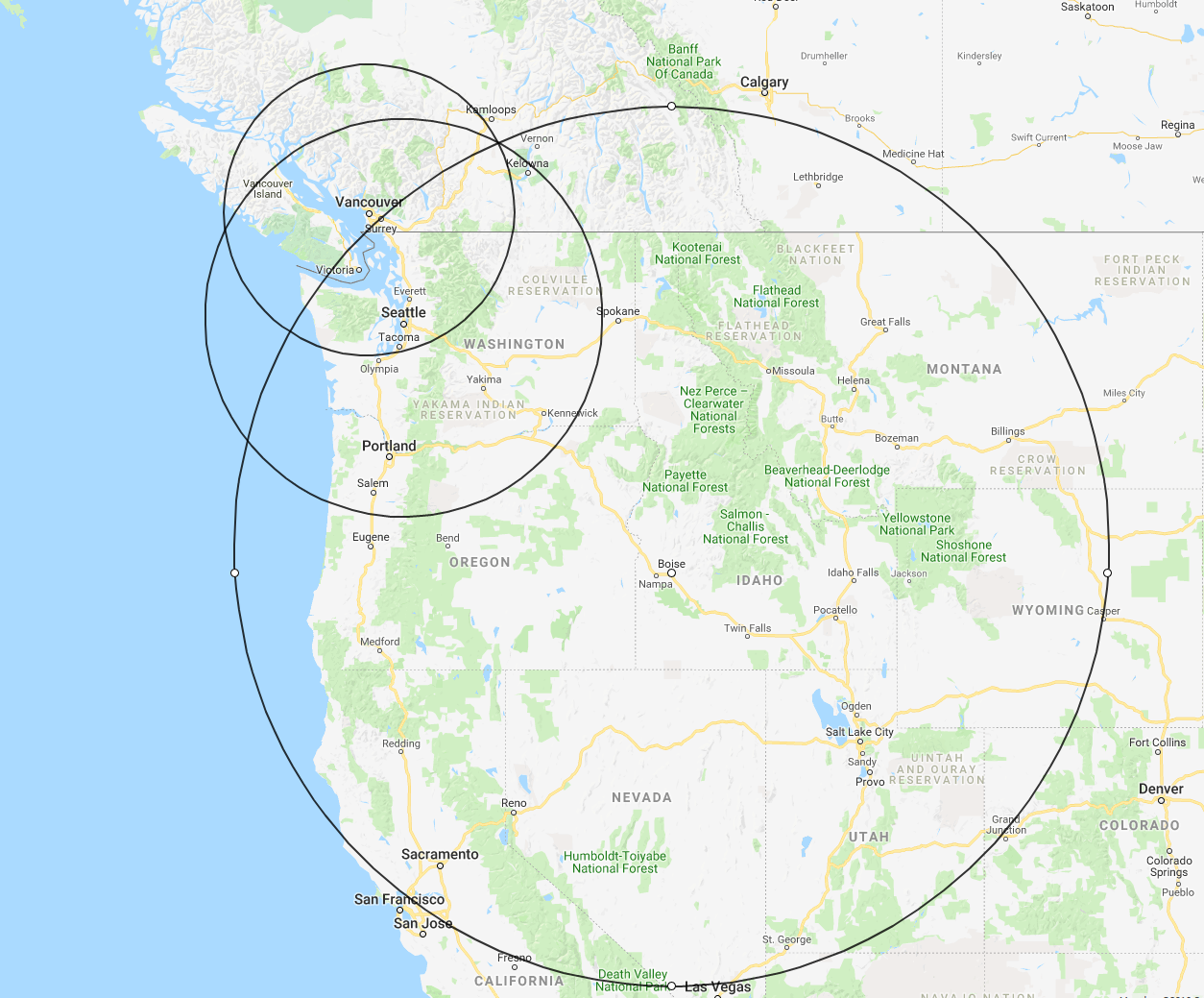
To begin with, consider what happens if you’re standing in an unknown location and you ask someone where you are. They reply simply- “You are 212 miles from Seattle, Washington.”

You now can draw a circle on a map with radius 212 miles from Seattle. Assuming the person giving you that information is correct, you know you’re somewhere along that circular line.

Not super helpful at this point by itself, you then ask someone else, and they say, “You are 150 miles from Vancouver BC.”  Now you’re getting somewhere. When you draw that circle on the map, you’ll see it intersects at two points. You are standing on one of those two points. Noticing that you are not, in fact, floating in the ocean, you could at this point deduce which point you are on, but work with us here people.

Instead of making such an assumption, you decide your senses are never to be trusted and, after all, Jesus stood on water, so why not you? Thus, you ask a third person- they say, “You are 500 miles from Boise, Idaho.” That circle drawn, you now know exactly where you are in two dimensional space. Near Kamloops, Canada, as it turns out.

This is more or less what’s happening with GPS, except in the case of GPS you need to think in terms of 3D spheres instead of 2D circles. Further, how the system tells you your exact distance from a reference point, in this case each of the satellites, is via transmitting the satellites’ exact locations in orbit and a timestamp of the exact time when said transmission was sent. This time is synchronized across the various satellites in the GPS constellation.

The receiver then subtracts the current known time upon receiving the data from that transmission time to determine the time it took for that signal to be transmitted from the satellites to its location.

Combining that with the known satellite locations and the known speed of light with which the radio signal was propagated, it can then crunch the numbers to determine with remarkable accuracy its location, with margins of error owing to things like the ionosphere interfering with the propagation of the signal, and various other real world factors such as this potentially throwing things off a little.

Even with these potential issues, however, the latest generation of the GPS system can, in theory, pinpoint your location within about a foot or about 30 centimeters.

You may have spotted a problem here, however. While the GPS satellites are using extremely precise and synchronized atomic clocks, the GPS system in your car, for example, has no such synchronized atomic clock. So how does it accurately determine how long it took for the signal to get from the satellite to itself?

It simply uses at least four, instead of three, satellites, giving it the extra data point it needs to solve the necessary equations to get the appropriate missing time variable. In a nutshell, there is only one point in time that will match the edge of all four spheres intersecting in one point in space on Earth. Thus, once the variables are solved for, the receiver can adjust its own time keeping appropriately to be almost perfectly synchronized, at least momentarily, with the much more precise GPS atomic clocks. In some sense, this makes GPS something of a 4D system, in that, with it, you can know your precise point in not only space, but time.

By continually updating its own internal clock in this way, the receiver on the ground ends up being nearly as accurate as an atomic clock and is a time keeping device that is then almost perfectly synchronized with other such receivers across the globe, all for almost no cost at all to the end users because the U.S. government is footing the bill for all the expensive bits of the system and maintaining it.

Speaking of that maintanence, another problem you may have spotted is that various factors can, and do, continually move the GPS satellites off their original orbits. So how is this accounted for?

Tracking stations on Earth continually monitor the exact orbits of the various GPS satellites, with this information, along with any needed time corrections to account for things like Relatively, frequently updated in the GPS almanac and ephemeris. These two data sets are used for holding satellite status and positional information and are regularly broadcast to receivers, which is how said receivers know exact positions of the satellites in the first place.

The satellites themselves can also have their orbits adjusted if necessary, with this process simply being to mark the satellite as “unhealthy” so receivers will ignore it, then move it to its new position, track that orbit, and once that is accurately known, update the almanac and ephemeris and mark the satellite as “healthy” again.

So that’s more or less how GPS came to be and how it works at a high level. What about the part where we said many GPS devices may potentially stop working very soon if not updated?

Near the turn of the century something happened that had never happened before in the GPS world- dubbed a “dress rehearsal for the Y2K bug”.  You see, as a part of the time stamp sent by the GPS satellites, there is something known as the Week Number- literally just the number of weeks that have passed since an epoch, originally set to January 6, 1980. Along with this Week Number the number of seconds since midnight on the previous Saturday evening is sent, thus allowing the GPS receiver to calculate the exact date.

So what’s the problem with this? It turns out every 1024 weeks (about every 19 years and 8 months) from the epoch, the number rolls back to 0 owing to this integer information being in 10 bit format.

Thus, when this happens, any GPS receiver that doesn’t account for the Week Number Rollover, will likely stop functioning correctly, though the nature of the malfunction varies from vendor to vendor and device, depending on how said vendor implemented their system.

For some, the bug might manifest as a simple benign date reporting error. For others, such a date reporting error might mean everything from incorrect positioning to even a full system crash.

If you’ve done the math, you’ve probably deduced that this issue first popped up in August of 1999, only about four years after the GPS system itself was fully operational.

At this point, of course, GPS wasn’t something that was so ubiquitously depended on as it is today, with only 10-15 million GPS receivers in use worldwide in 1999 according to a 1999 report by the the United States Department of Commerce’s Office of Telecommunications. Today, of course, that number is in the billions of devices.

Thankfully, when the next Week Number Rollover event happens on April 6, 2019, it would seem most companies that rely on GPS for critical systems, like airlines, banking institutions, cell networks, power grids, etc., have already taken the necessary steps to account for the problem.

The more realistic problems with this second Week Number Rollover event will probably mostly occur at the consumer level, as most people simply are not aware of the issue at all.

Thankfully, if you’ve updated your firmware on your GPS device recently or simply own a GPS device purchased in the last few years, you’re probably going to be fine here.

However, should you own a GPS device that is several years old, that may not be the case and you’ll most definitely want to go to the manufacturer’s website and download any relevant updates before the second GPS epoch.

That public service announcement out of the way, if you’re now wondering why somebody doesn’t just change the specification altogether to stop using a 10 bit Week Number, well, you’re not the first to think of this. Under the latest GPS interface specifications, a 13 bit Week Number is now used, meaning in newer devices that support this, the issue won’t come up again for about a century and a half. As the machines are bound to rise up and enslave humanity long before that occurs, that’s really their issue to solve at that point.

If you liked this article, you might also enjoy our new popular podcast, The BrainFood Show (iTunes, Spotify, Google Play Music, Feed), as well as:

Bonus Facts:

  • Ever notice that your cell phone tends to lock on to your GPS position extremely quickly, even after having been powered off for a long time? How does it do this when other GPS devices must wait to potentially receive a fresh copy of the almanac and ephemeris? It turns out cell phones tend to use something called Assisted GPS, where rather than wait to receive that data from the currently orbiting GPS satellites, they will instead get it from a central server somewhere. The phone may also simply use its position in the cell phone network (using signals from towers around) to get an approximate location to start while it waits to acquire the signal from the GPS satellites, partially masking further delay there. Of course, assisted GPS doesn’t work if you don’t have a cell signal, and if you try to use your GPS on your phone in such a scenario you’ll find that if you turn off the GPS for a while and then later turn it back on, it will take a while to acquire a signal like any other GPS device.
  • Starting just before the first Gulf War, the military degraded the GPS signal for civilian use in order to keep the full accuracy of the system as a U.S. military advantage. However, in May of 2000, this policy was reversed by President Bill Clinton and civilian GPS got approximately ten times more accurate basically overnight.
  • The military also created the ability to selectively stop others from using GPS at all, as India discovered thanks to the Kargil conflict with Pakistan in 1999. During the conflict, the U.S. blocked access to the GPS system from India owing to, at the time, better longstanding relations between the U.S. and Pakistan than the U.S. had with India. Thus, the U.S. didn’t want to seem like it was helping India in the war.
Expand for References

The post How Does GPS Actually Work and Why Many GPS Devices are About to Stop Working appeared first on Today I Found Out.


from Today I Found Out
by Daven Hiskey - March 26, 2019 at 08:05AM
Article provided by the producers of one of our Favorite YouTube Channels!
-

Beneath a Steel Sky to get a sequel titled Beyond a Steel Sky

Back to Bed brings its surreal sleepwalking puzzles to the...


Back to Bed brings its surreal sleepwalking puzzles to the Switch in April https://buff.ly/2FyLFGW noreply@blogger.com (WitWGARA) - March 25, 2019 at 09:51AM A place for #OurMischief: https://buff.ly/2N2FVao
https://ift.tt/2U73AfZ
March 26, 2019 at 07:30AM


via Tumblr https://ift.tt/2CDePTt

Monday, March 25, 2019

Apple Arcade is Apple’s game subscription service, coming later this year

Review: SE Grocers Sriracha Flavored Wavy Potato Chips


These potato chips had wide, curvy ripples and fairly flat overall shapes for most of the pieces. ...

from Taquitos.net Snack Reviews
by March 25, 2019 at 10:59AM

Alien vs. Godzilla! Should it be a thing?


https://ift.tt/2HGUNLV
Alien vs. Godzilla! Should it be a thing?
March 25, 2019 at 11:04AM

https://ift.tt/2FyqDYK

Back to Bed brings its surreal sleepwalking puzzles to the Switch in April

Bite UK snacks launches range for Yo!


Bite UK Snacks is set to produce a range of snacks under the Yo! brand.

The range has been developed exclusively for Yo!, the sushi and fresh Japanese food company to complement their concessions in Tesco stores and existing restaurant ranges.

Bite UK Snacks founder Jason Bull said; “It is an exciting opportunity to work with a creative mainstream brand such as Yo! to develop a unique product that sits perfectly within their portfolio. We are leading the charge in bringing the British public delicious snacks which have better-for-you credentials.”

Marketing director, Yo! Group, Luisa Fernandez, said; “We are delighted to enhance our customer’s eating experience with these delicious snacks. Bite UK Snacks are the perfect trusted partner to produce both the taste and health credentials that our customers expect.”

The range is made up of rice cakes and Pop Chips. Savoury Pop Chips are air-popped, not fried, to make a healthier alternative containing over 50% less fat compared to a fried potato crisp. The new range is available in the following variants:

  1. YO! Chocolate and Salted Caramel Rice Cake, 39g
  2. YO! Chocolate and Coconut Rice Cake, 39g
  3. YO! Salt and Vinegar Pop Chips, 20g
  4. YO! BBQ Pop Chips, 20g

The post Bite UK snacks launches range for Yo! appeared first on Sweets & Savoury Snacks World.


from Sweets & Savoury Snacks World
by Katherine Skeates March 25, 2019 at 07:44AM

Among the Sleep to mark fifth anniversary with Switch release and more

Sunday, March 24, 2019

Do You Get Your Stuff Back If You Go Missing, are Declared Dead, Then Turn Up Alive like a Certain Shire Hobbit?

ScrobTheFancyTurtle asks: Love your video on what happens when people are accidentally declared dead. But it got me wondering, what happens if you make a will, go missing, so your will is executed, then turn up alive later? Do you get your stuff back?

As we discussed in our article on what happens to a person who is accidentally declared dead and the process in getting declared alive again, tens of thousands of people die each year across the globe by a simple clerical error, at least as far as their respective governments are concerned. However, what we didn’t mention is that many thousands more people are more purposefully declared “dead in absentia” each year.

As you’ve probably surmised from the term used to describe these deaths, being declared dead in absentia occurs after a person goes missing. When this happens, their will is probated and estate settled. But what happens if they aren’t dead at all and turn up later, perhaps after helping a tempestuous, but lovable bunch of vertically challenged individuals reclaim their homeland from the clutches of the Chiefest and Greatest of Calamities? How do they go about getting their stuff back, or do they even have any rights to it at all anymore?

To begin with, how does one go about getting declared “dead in absentia” in the first place?  After all, in most countries adults are perfectly within their rights to uproot and go start a new life somewhere else without telling anyone, or even go on a lengthy adventure with a wizened grey wanderer.

Before we jump into the meat of all this, just a quick note, as this particular topic deals with estate distribution and the like, we’ll focus primarily on adults who disappear, though many elements of what we’re about to cover does also technically apply to children.

As with many things, there’s no uniform, worldwide policy concerning what exact set of circumstances need occur or even how long a person needs to be missing to be declared dead in absentia, though there are many similarities in the process from country to country.

In general, the courts will have to be directly involved in these cases and they will almost always err towards presuming the person is actually alive. However, if the person has been missing for a specific length of time, with no one who would otherwise normally hear from them having contact, and a diligent (unsuccessful) search has been conducted to find them, the courts will ultimately determine that the person indeed must be deceased, even if there is no direct, hard evidence that they are, in fact, dead.

As to the search, to dispel a popular notion frequently perpetuated by Hollywood, a person does not have to be missing for more than 24 hours before authorities in most countries will act. In fact, while almost all missing person cases are resolved of their own accord in relatively short order, in rare more legitimate missing person cases, every hour that passes reduces the probability that said missing person will be found and nobody is more aware of this than the authorities who deal with this stuff every day. Thus, they often actually recommend reporting missing people as soon as the person is determined to be missing.

That said, given there is only so much manpower available at any given time and, again, most missing person cases resolve themselves of their own accord rather quickly, the appropriate authorities do have to prioritize what cases they take on immediately. Thus, rather than strictly going by how much time has passed before an investigation is opened, they’ll weight a number of factors including the probability that the person is truly missing, and not just off doing something without telling anyone. If the disappearance is highly unusual given the person’s normal daily habits and no good explanation can be thought up for the disappearance, this will bump the case up in the priority list as a potential legitimate missing person case. Just as important in getting the authorities to look into the matter immediately is the probability that the person missing might be in some sort of peril given the known facts of the case.

Once an investigation is started, if nobody in the person’s life seems to have heard from them or knows where they are, authorities usually resort to monitoring the person’s digitally trackable life, for example where applicable monitoring financial accounts, cell phone, email, social media accounts, etc., as well as checking if the person has attempted to go through any border check points. As you might imagine, disappearing without a trace in the modern world has become increasingly difficult, meaning these days authorities are much more frequently able to locate the person if they are indeed still alive, compared to even just a few decades ago.

It also helps that many people who are choosing to disappear from their previous lives are not trying to hide from authorities, so the use of personal bank accounts and the like tends to continue.

If they are found, the authorities will typically respect the person’s right to disappear from a former life, unless there are legal reasons not to, such as someone running from financial obligations or the like. As Miranda Napier of the Missing Persons Bureau notes,

If someone has elected to leave their friends and family… and we find them and they express this wish, then we would close the missing report and advise those making it that they were safe and well, but we would not be able to tell them where they were.

Speaking of financial obligations, when trying to decide if some missing person might actually be dead, authorities will also analyze whether the person missing might have had motive to go missing in the first place. For example, if they were having extreme financial difficulties, were in legal trouble, having relationship or family problems, etc.

As they move along in the process, authorities will also usually check with local coroners to see if any unidentified bodies have been found that match the description of the missing person.

But what about if all of this turns up nothing? Next, it becomes a waiting game. In regards to the length of time needed, as noted, this varies, but a commonly observed rule of thumb is that the person has to have been missing for at least 7 years, unless circumstances of their disappearance seem to indicate imminent peril, thus a high probability that the person is, in fact, deceased.

For example, many bodies couldn’t be identified or recovered when the World Trade Center towers collapsed on 9/11, so people who worked there who went missing directly after would have an extremely high probability of being declared dead in absentia almost immediately should their loved ones request such of the courts.

Few cases are so cut and dry, however, and in all cases you generally need to get a judge to agree with you, with the burden of proof lying with the people trying to get someone declared dead earlier than the required number of years. The judge in these cases will then determine if, given the evidence, the probability has shifted from presuming the person is alive to it being reasonable to presume they are dead, again usually erring on the side of assuming the person is still alive.

As former assistant attorney general of Illinois, Floyd Perkins notes, “Before seven years, anyone who wants you declared legally dead has to offer evidence that you’re not alive. But after you’ve been missing seven years, anyone who wants you declared alive has to offer evidence that you’re not dead.”

As for more specifics, in the United States the authority to declare someone dead in absentia falls to the states themselves, each of which have their own specific rules. For example, while most states go with the seven year general rule, states like Georgia and Minnesota instead go with four years.

Moving around to the other side of the world, in Italy, it actually takes 20 years for someone to be declared dead in absentia, barring compelling evidence to decree this sooner. In Poland, the time span is 10 years. In Russia, it’s 5.  Like in many states in the U.S. and many other parts of the world, in the UK, there is a 7 year waiting period before the authorities can make this call.

It should be noted here that until the authorities declare the person dead, the missing person’s financial affairs are basically in a state of bureaucratic limbo. To illustrate the issues here, consider the case of Vicki Derrick, a woman whose husband Vinny went missing in 2003. After an investigation to locate Vinny turned up nothing, he was presumed missing by the police.

The problem was that in the eyes of the law Vicki’s husband was still alive and, thus, she was still married to him with all obligations that implies, still shared a mortgage on a house she could no longer afford with just a single income, but could also not sell because her husband wasn’t around to put his signature on the necessary paperwork to sell it.

Furthermore, Vickie couldn’t claim her husband’s life insurance policy nor access his personal accounts to settle his various financial obligations until the courts finally decided enough time had passed to declared him dead in 2011.

In a bizarre twist, Vinny’s body was found just two months after he was finally declared dead in absentia. As Vicki would later recount,

There was a huge sense of relief, which I felt guilty about. But at the same time I had already grieved. Deep down I think I knew the day he disappeared he wasn’t coming back. It was so out of character that something terrible must have happened for him not to come home.

It turns out that in the UK alone, while about 98% of the 250,000 or so people that go missing each year turn up within a week of their disappearance, about 1% of these people go missing for at least a year.  In a little over half of these 1% cases, the person is ultimately either found dead or eventually declared dead in absentia, but the other half, over 1,000 missing people annually, turn up alive in the end.

As a direct result of cases like these, the government passed the Guardianship (Missing Persons) Act in 2017 which, 90 days after the disappearance of the individual, allows the loved ones of a missing person to assume some degree of control over their affairs.  Thanks to this, many of the problems people like Vickie faced can be avoided, mitigating the potential damage to a missing person’s financial situation as well as providing a degree of help in cutting through a lot of red tape for their loved ones during a tumultuous time.

No such nationwide laws exist in the United States and, thus, for example if any benefits would otherwise have been paid, the beneficiaries involved usually simply have to wait the required period for the death in absentia to be declared before they can begin receiving them, assuming they can’t offer a sufficient body of evidence to get the person declared dead early.

Alright, so that’s how you could potentially be declared dead and have your estate pass to others without actually being dead. So let’s now talk about your stuff.

In a nutshell, a person declared dead in absentia is, by the letter of the law, dead.

Shocker, I know.

As such, the actual process of probating their will is functionally identical to a more straightforward death in most countries. Likewise, death benefits will similarly be paid out in a timely manner, though some insurers may require a person making a claim in these cases to jump through a few additional hoops, such as providing evidence a good faith effort was made to locate the person before death in absentia was declared. With this information being necessary to declare a person dead in absentia anyway in most cases, this usually is a pretty easy hurdle to jump over at that stage of the game.

But let’s say after all this happens the “dead” person turns up very much alive and wants all their stuff back from the clutches of the Sackville Baggins. What happens then? This is a far more thorny legal issue and there’s little universal precedent in law to say what exactly should happen, though in the vast majority the court cases we could found, the heirs typically weren’t required to give anything back.

In the US especially what happens in this unlikely scenario varies slightly from state to state, with some dictating that the person has no right to any of their stuff back and others adding caveats, including Pennsylvania who deals with the matter perhaps most sensibly of any region we looked at.

Another example of a state with a caveat is Nevada, where a missing person has up to a year after legal proceedings to divide up the estate have begun to veto the whole thing and get their money and property back, despite having been previously declared dead in absentia. If a missing person turns up after this grace period, they will no longer have any claim to their former assets.

To give the missing person as much of a chance as possible to prevent this from happening if they are indeed still alive, a person laying claim to the estate to the missing person in this case must “give notice by publication”.  This mostly just means doing something like putting an ad in a local paper or the like that they are going to make a claim on the estate, which is sure to be read by no one but the intern who processed the notice, but at least gives the appearance of accomplishing something, so is a bureaucrat’s dream law.

Moving on to Pennsylvania, the state law very sensibly requires anyone laying claim to a person’s estate who has been declared dead in absentia to secure a refunding bond before assets will be distributed. As Pennsylvania-based attorney Patti Spencer states, “The person entitled, a spouse or kid, has to post a refunding bond, before the property is distributed. If the person comes back… and someone else has her property, they have to give it back, and if they can’t, then this bonding company has to make it right.”

This is something that happened relatively recently as 2013 when a woman named Brenda Heist returned after her presumed death in 2003. She’d actually been living on the street for the last decade and hadn’t even been aware she had been declared dead.

UK law, as with many other countries we looked at, seems to more or less handle things about the same as the general U.S. court systems. If the person has been declared dead in absentia and sufficient time has passed, which is usually needed to get declared dead in absentia in the first place, the courts will usually rule that the heirs aren’t required to give anything back, though, of course, any heirs are free to do so at their own discretion. The courts simply usually won’t require them to do so if a lawsuit is raised over the matter, though, as with all things in life, their are exceptions.

But what about life insurance and various death benefits? As you might imagine, the insurance companies will almost always seek to get their money back, unless the cost to do so exceeds the amount paid out. But from whom do they try to get the money back from?  While, as with so much of what we’ve just discussed it’s not universally true, if a missing person’s loved ones have them declared dead in absentia and then claim against their life insurance policy in good faith (and thus aren’t involved in any fraud here), they won’t generally be sued for the money back, or, even if they are, the courts are unlikely to side with the insurance company in these cases.

The life insurance companies tend to have much better luck going after the person who was incorrectly declared dead in absentia. After all, the missing person knows they are still alive and usually went missing on purpose, setting off the chain of events that required the insurance company to eventually pay out on a policy when they otherwise shouldn’t have been obligated if the missing person had just told someone they weren’t dead.

For example, consider the case of John Burney who disappeared, in this case in a way that made it seem very likely he was dead, in 1976 after getting in some rather hot water owing to mismanagement of his company, causing it to go bankrupt. About six years later, in 1982, he was found to be alive when he decided to return home to visit his father who had been seriously injured. Although Burney’s insurance company initially filed suit against the beneficiaries of his life insurance policy – specifically his wife and business partners – the courts ruled that they didn’t have to return the money. Burney, however, who didn’t receive a dime of that insurance money, did, to the tune of $470,000 (about $1.2 million today).

So to sum up, if you do happen to mysterious disappear and then turn up again after being declared dead, chances are your stuff will be gone unless your beneficiaries are feeling particularly generous and choose on their own to give it back.  And should they have cashed in on a life insurance policy you had, assuming they really thought you were dead when they did it, you are likely going to be the one on the hook to pay that back, even if you didn’t benefit from it in any way. To add insult to injury, particularly if you live in the United States, prepare yourself for quite the lengthy ordeal in getting yourself declared alive again in the first place, with a number of rather severe consequences while you try to prove to everyone that you are, in fact, not dead.

Thus, unfortunately for the owner of a certain estate along Bagshot Row, given his disappearance most definitely was out of the ordinary for his normal behavioral patterns and, beyond that, he was last seen, at least in the film adaptation, noting he was “going on an adventure” (always a dodgy business), in either case those seeking his estate seem perfectly within their rights to have had him declared dead in absentia. Assuming Shire law did not have a grace period for legal right to recover an estate after such a declaration, like Nevada, it seems likely all property already auctioned off would not have been obligated to have been returned.

If you liked this article, you might also enjoy our new popular podcast, The BrainFood Show (iTunes, Spotify, Google Play Music, Feed), as well as:

Expand for References

The post Do You Get Your Stuff Back If You Go Missing, are Declared Dead, Then Turn Up Alive like a Certain Shire Hobbit? appeared first on Today I Found Out.


from Today I Found Out
by Karl Smallwood - March 22, 2019 at 12:00AM
Article provided by the producers of one of our Favorite YouTube Channels!
-

Saturday, March 23, 2019

Inside Tomb of Horrors, the hardest D&D module ever made...


Inside Tomb of Horrors, the hardest D&D module ever made https://buff.ly/2Fib0EX ⠀
⠀
This article includes spoilers for the Tomb of Horrors D&D module.⠀
⠀
The first thing you’ll likely hear of Tomb of Horrors, a Dungeons and Dragons … https://buff.ly/2N2FVao
https://ift.tt/2URRaFJ
March 23, 2019 at 06:30PM


via Tumblr https://ift.tt/2OnXbYc

Review: Cheetos Eggs Double Cheddar


This version of Cheetos adopted the shape of the Cheetos Sweetos, which were supposed to look like Easter eggs with two stripes across the middle, but instead of the Sweetos Cinnamon or Caramel flavors, they stuck to what Cheetos are known best for, along with the usual Cheetos fluorescent orange color. ...

from Taquitos.net Snack Reviews
by March 23, 2019 at 06:06PM

Friday, March 22, 2019

Chucklefish shares new gameplay of Indiana-Jones-esque strategy...


Chucklefish shares new gameplay of Indiana-Jones-esque strategy adventure Pathway https://buff.ly/2Hx0Bqt ⠀
⠀
Developer Robotality (previously responsible for sci-fi strategy-RPG Halfway) has unveiled a big wedge of new gameplay fo… https://buff.ly/2N2FVao
https://ift.tt/2WjNNYn
March 22, 2019 at 03:00PM


via Tumblr https://ift.tt/2WfDC7h

Popped lotus seed brand Guruji hits UK shelves


Snacking brand Guruji is set to launch its innovative range of snacks made of popped lotus seeds.
Lotus seeds have been valued in India and China for centuries for their nutritional composition, and have recently hit UK shelves. Hailed as a credible alternative to popcorn and crisps, Guruji’s product range includes four variants: Smoky Thai, Cheesy Vegan, Lightly Salted and Salt & Cacao.
Founder Akhil Kumar said: “I have Northern Indian heritage, and the Bihar region is where the majority of India’s supply is produced. I grew up eating the seeds and knowing about their notable health credentials, and they were also the perfect replacement to snacking on nuts due to my allergies. With Guruji, we have taken all the health properties of the seeds and made them exciting for a Western audience, by layering them with punchy gourmet flavours specifically designed for this market.”
“While not first to the UK market, we have a secure supply chain which provides premium, consistent lotus seeds, so we are confident that every pack of Guruji delivers. They taste fantastic, are healthy and satiating, and therefore provide the perfect snack.”
Guruji’s popped Lotus seeds are handmade in the UK, naturally gluten-free, vegan, low in calories and are a source of plant-based protein. They also have a sustainable life-cycle and are hand-farmed; no machinery is used in the process meaning their product is not extruded. Lotus seeds are grown using natural water supplies.
The post Popped lotus seed brand Guruji hits UK shelves appeared first on Sweets & Savoury Snacks World.


from Sweets & Savoury Snacks World
by Katherine Skeates March 22, 2019 at 07:21AM

Thursday, March 21, 2019

Two years after its announcement, Axiom Verge finally gets a...


Two years after its announcement, Axiom Verge finally gets a physical release on Wii U https://buff.ly/2TVEW1w ⠀
⠀
Limited Run Games has announced that it will be releasing a physical edition of Axiom Verge on Wii U at the end of t… https://buff.ly/2N2FVao
https://ift.tt/2UVQm2w
March 21, 2019 at 07:30PM


via Tumblr https://ift.tt/2U01m1T

Radioactive Sours


I didn't have protective gloves when I tasted these, so it's possible I'm now part mutant.

from Candy Gurus
by Jonny March 21, 2019 at 10:35AM

Wednesday, March 20, 2019

Tuesday, March 19, 2019

Monday, March 18, 2019

Monster Boy and the Cursed Kingdom is getting a demo on Switch...


Monster Boy and the Cursed Kingdom is getting a demo on Switch this week https://buff.ly/2u1VI0o ⠀
⠀
If you’ve been on the fence about developer Game Atelier’s astonishingly good Wonder Boy revival Monster Boy and the Cursed Kingdo… https://buff.ly/2N2FVao
https://ift.tt/2Tb1p6s
March 18, 2019 at 08:30AM


via Tumblr https://ift.tt/2UGORFB

Nintendo Switch adult Mahjong game pulled due to poor censorship

A Nintendo Switch version of Mahjong, the ancient Chinese game about removing tiles, has been pulled from the Japanese eShop for containing poorly-censored nudity.

Super Real Mahjong PV originally launched on the Sega Saturn, and was designed to titillate players with 32-bit hentai as a reward for completing levels. Super real, it was not.

Back to 2019, where the game's eyebrow-raising reappearance on Switch in Japan includes a lazy attempt to cover up its characters. Light beams now censor parts of each image - making it look like you're staring at Microsoft Paint drawings of women in Japanese schoolgirl costumes, while someone shines a torch into your eyes to ask what on earth you think you're doing.

Read more


from Eurogamer.net
by March 18, 2019 at 05:08AM

Tom Clancy's The Division 2 review - an accomplished sequel with an awful story

There are a few things you can count on me to be embarrassed by on any given day - my beer gut, for example, or the time I called my teacher 'mum' when I was six. One of the things embarrassing me most at the moment is how much I like The Division 2, because it is a game that manages to be both great and repugnant.

Let's start with the good stuff - The Division 2 is a very well made cover shooter. The core experience introduced in the first game is still gripping, offering countless busy set pieces with just enough of a challenge to make its players feel like part of a well oiled machine.

Skills remain a big part of the game, offering a wide array of sophisticated, deadly and very often daft gadgets to help agents get an edge on their opponents. The range of core skills - and variants of those skills - has been greatly expanded for the sequel, which now boasts a drone that can fix your armour, chemical launchers that can stick people to the spot, and a silly device that zips around the screen attaching magnetic grenades to pre-selected targets before quite often flying into the nearest wall. The gear system has also undergone some changes. Items of gear now have manufacturers - effectively gear sets - adding a layer of complexity to your equipment loadout that can offer some useful perks. Weapon mods, meanwhile, now feature one negative trait along with a positive one, making customisation more of a challenge.

Read more


from Eurogamer.net
by March 18, 2019 at 05:00AM

The Division 2 physical launch sales just 20% of Division 1's

The Division 2 sold far fewer physical copies during its launch week than the series' first entry, back in 2016.

Ubisoft's latest Tom Clancy-'em-up shifted just 20 per cent of the boxed copies of its predecessor. As ever, UK numbers do not include digital sales.

So why the huge plummet? Well, Division 1 launched on a Tuesday in the UK, compared to Division 2's Friday arrival. The first game had a little longer to rack up numbers.

Read more


from Eurogamer.net
by March 18, 2019 at 03:19AM

Glorious pixel physics rule in Noita

If this is mud that's falling from the cavern above, having pooled in divots and then lapped and slopped over the edges, then why does it settle on top of the water in this beautiful subterranean lake? And why is that guy with flames for hands and feet and flames for a head walking towards me?

Oh, it's not mud at all. It must be oil. Because now everything is ablaze, fire arcing over the surface of the lake, boiling the lake dry, racing upwards to the cavern above and the overflowing divots. Now I'm on fire. Now the ground's giving way. Now I'm landing in fresh green water. Except it's acid rather than water. At least I'm not on fire anymore!

At least I'm not on fire anymore. Noita - I think it's a Finnish word for 'witch' - is the kind of game that has you counting your blessings, however small. It's a 2D procedural exploration game in which you play a robed adventurer heading deep underground with a bundle of magic wands for company. You can aim in any direction and you can levitate for a bit and you can kick things around if they're light enough. Secrets and enemies lurk all about.

Read more


from Eurogamer.net
by March 18, 2019 at 01:01AM

Sunday, March 17, 2019

Review: Cheez-It Snap'd White Cheddar & Bacon


This version of Snap'd had the same shapes as the Jalapeño Jack and Double Cheese flavors, with a yellow color and a smattering of green seasoning bits on the surfaces. ...

from Taquitos.net Snack Reviews
by March 17, 2019 at 05:06PM

Review: Asian Boy (E.B.Q.) Sesame Seed Cookies


This package contained eight separately wrapped "cookies," but really they looked like mini-bars. ...

from Taquitos.net Snack Reviews
by March 17, 2019 at 04:42PM

Here's what Star Wars Dark Forces looks like remade in Unreal Engine 4

A developer from Obsidian is remaking Star Wars Dark Forces in Unreal Engine 4.

Jason Lewis - who works as a professional senior environment artist at Obsidian - has been working on this passion project for a few years now, starting out with plans to simply recreate A New Hope's Mos Eisley spaceport as a Dark Forces "art project". Now, however, the project has expanded to a fan-made recreation of Dark Forces, complete with a newly released playable work-in-progress demo.

If you're too young to remember it the first time around (i.e. you're not as old as I am), Star Wars: Dark Forces was a 1995 first-person shooter developed by Lucasarts. Sadly, this remake doesn't feature any shootable bad dudes, but you can experiment with the blaster, take a tour of the Millennium Falcon, and spend some quality time with R2-D2.

Read more


from Eurogamer.net
by March 17, 2019 at 10:53AM

BioWare tweaks Anthem's "loot drop rate"

EA has confirmed that it's made "some notable changes to the loot drop rate" in Anthem.

Whilst only divulging that the changes were coming to "specific scenarios", the short-n-sweet update on the official website confirmed the server-side update (which means you don't have to download or apply it to your local system) would immediately boost the chances of top-tier gear drops at the game's highest difficulty levels... as well as some improvements for the hardest enemies on any difficulty setting, too.

"In the latest server-side update, we've made some notable changes to the loot drop rate in specific scenarios, which will take effect immediately in a server-side tuning update," EA said. "These changes include: Masterwork & Legendary drop rates have been increased for Grandmaster 2 and Grandmaster 3 difficulty levels, and Masterwork & Legendary drop rates have been increased for harder enemies at all difficulty levels. This includes: Legendary Ancient Ash Titan, Elite Ancient Ash Titan, Legendary Fury, Legendary Ursix and Legendary Luminary."

Read more


from Eurogamer.net
by March 17, 2019 at 10:04AM

This dataminer reckons they know what's coming up in The Division 2's all-new raid

A dataminer believes they've uncovered what's coming up in The Division 2's first eight-man raid, Operation Dark Hours.

In a post on reddit (thanks, PCGN), kevindavid40 believes they have "managed to decrypt the game asset file" and lists, in astonishing detail, what they believe the raid will include. While we often see nefarious attempts to convince players of false "leaks", kevindavid40's claims are interesting given the astonishing detail they provide.

"Morning Agents!" kevindavid40 said. "I managed to decrypt the game asset file, and got more interesting info on the upcoming Raid. I'm just going to say it looks true hardcore end-game activity based on the size of the map, and the objectives involved in this Raid."

Read more


from Eurogamer.net
by March 17, 2019 at 09:24AM

A new Sonic game is in development

Takashi Iizuka has confirmed the next main Sonic game has "begun production".

Talking at the SXSW Sonic panel this weekend (thanks, PCGN), Team Sonic were keen to temper expectations - apparently, we're unlikely to see anything concrete about the new instalment until next year - but said the team "will be excited to share more news with you in the future, but for now, thank you for your patience until we have something to show".

The panel also revealed an all-new trailer for upcoming Team Sonic Racing, scheduled to drop on Nintendo Switch, PC, PlayStation 4, and Xbox One on 21st May, 2019. The teaser offered a peek at the new customisation options - albeit ones that stop short at full character creation, sadly - as well as a little glimpse of the game in action. Players are able to tweak pretty much everything about their vehicle, from handling and defence to acceleration and paint finishes, and even the sound of your horn. Here, take a look:

Read more


from Eurogamer.net
by March 17, 2019 at 08:18AM

DF Retro: Killzone 2 ten years on - a PS3 showcase that still looks stunning today

The road to Killzone 2 was almost certainly a difficult one fraught with unrealistic expectations defined by its infamous E3 2005 pre-rendered trailer - but despite the odds, developer Guerrilla Games managed to produce one of the most visually striking games of the generation. Even today, Killzone 2 stands head and shoulders above most games released for PlayStation 3 in terms of both technical ambition and artistic vision. Revisit the game yourself and see what I mean - it still looks stunning.

The original Killzone released on PS1 in 2004 to average reviews, but there was a spark there that suggested the potential for something greater. The atmosphere was thick and the visuals ambitious for the platform, animation on weaponry was remarkably robust and the game even featured multiple playable characters. Unfortunately, Killzone is ultimately let down by a remarkably choppy frame-rate and often poor mission design, but for many, the Killzone name and Guerrilla Games itself only took centrestage at E3 2005 with the reveal of PlayStation 3.

This now infamous trailer showcased a level of detail and fidelity unlike anything we could imagine at the time and for good reason - the trailer was completely pre-rendered and, according to Guerrilla, was never intended to represent the final game. Indeed, some sources tell us it was never meant for public consumption. The Amsterdam-based studio barely had a single triangle displaying on PS3 devkits at the time, but thanks to a comment made by Sony exec, people were led to believe it was real. As a result, this trailer potentially made development of the game more difficult for the team with public expectations centered around a piece of media that simply wasn't representative of what could be achieved. It would be two years before we saw Killzone 2 again, and three-and-a-half years before the final game would emerge.

Read more


from Eurogamer.net
by March 17, 2019 at 07:00AM