Showing posts with label Nasser Ayash. Show all posts

Wednesday, February 1, 2023

When Does a Hill Become a Mountain?

Ever wonder when a hill becomes a mountain? Well, it turns out that language, like the universe, likes to resist simplicity… So the answer is- it’s complicated. But that’s not very interesting, so let’s dive into it shall we?

To begin with, turning to our trusty Merriam-Webster Dictionary we have the following definition of a mountain: “a landmass that projects conspicuously above its surroundings and is higher than a hill”

Helpful…

Maybe the Oxford English Dictionary can do better? According to this bastion of English awesome, mountains are “a natural elevation of the earth surface rising more or less abruptly from the surrounding level and attaining an altitude which, relative to the adjacent elevation, is impressive or notable”

As you can see, the dictionaries of the world are slightly less than helpful at nailing down precise specifications of what constitutes a mountain vs a hill. And, it turns out, science and various countries and institutions are equally unhelpful, coming up with a variety of ways to define this in a specific case, though there are some general things to consider when trying to classify a given bump in the ground.

Now, as will come as a shock to absolutely no one, in all such cases, one of the main parameters for distinguishing hills and mountains is size. Tall enough, it’s a mountain and falling short it’s a hill. This would make the problem simple enough if that’s really the only defining attribute accounted for: Find a threshold above which you are atop a mountain and below which you are on a hill.

This is exactly what many countries, including merry old England used to do until the 1920s. Perhaps the most well-known discourse about the subject is the 1990s movie “The Englishman who Went up a Hill but Came Down a Mountain” where some Welsh villagers are appalled with Hugh Grant’s notion that their village’s mountain is – in the eyes of the Central English Bureaucratic Geographic Association – only a hill, but barely.

Moving on from size, another common idea is that a hill is a smooth rounded mound of earth, a bump in the natural landscapes, often remaining unnamed.  A mountain, on the other hand, must have a steep inclination. It thus dominates the landscape, messes with the path of clouds and, of course, has a name.

But this description only pertains to the extreme examples of ragged and spikey terrain. These, however, are merely a characteristic of geologically younger mountains, such as the Andes, the Alps or the Rocky Mountains. Geological grand-dad mountains can have a more smooth surface, such as the Pocono mountains in Pennsylvania.

Thus, to clarify things a bit, in 1936, Roderick Peattie, publisher of “Mountain Geography”, gave mountains three defining characteristics: They should be impressive, they “should enter into the imagination of the people that live in their shadows”, and they should have “individual character” and play a symbolic role in the local area.

If that still sounds vague to you… well, it is. But surely, there must be some harder rules? The answer is… no, not precisely.

As alluded to, until the 1920s, the British Ordnance Survey defined a mountain as a geographic feature rising higher than 1,000 feet (304 meters) from surrounding ground level. This arbitrary line is behind the plot of that Hugh Grant movie, as the villagers had to build up the additional distance needed to reach the threshold. America followed the same trend until the 1970s.

Nowadays, however, as Mr. Peattie suggested, local tradition plays a major role: Generally, a mountain should have a minimum height of 610 metres (2000 feet), but if the locals have always considered their hill a mountain, well, let’s not anger them just for the sake of size. It is, after all, not always about size, but presence and reputation. This is particularly the case if the subject observed is a single elevation in otherwise flat areas, so relativity should also be considered. Similarly, you may be a male the size of a stereotypical jacked up truck owner, but if there are no other men anywhere in a geographical area, we’re sure the ladies will still sing your praises anyway.

Today, the leaders in geography, like the United States Geological Survey (USGS), also do not have an exact definition of “mountain” and “hill”. Instead, the organization’s Geographic Names Information System (GNIS) tries to follow some of the aforementioned few generally accepted characteristics, again, things like climbability, is it characteristic in the landscape, what do the locals consider it, and so on and so forth.

Moving on from hills and mountains, perhaps we can better have clarity with regards to seas and lakes?

To begin with, simply put, if it has a significant amount of salt it is a sea and if it is surrounded by land then it is a lake. Of course, sometimes bodies of water fit both bills, such as the Dead Sea and the Caspian Sea, in which case people just call it as they see it, although sometimes this can have major political ramifications.

For example with the Caspian Sea, its classification is, in fact, a very political issue, as international waters have different legislative status depending if it is a sea or a lake. Adding pressure to the situation is the fact that the Caspian Sea is an area rich in oil and the countries sharing the borders – among others Russia and Iran – are not exactly known as meek in their political stances. So the status of the Caspian… waters has been an ongoing issue for decades. Before the fall of the Soviet Union. The problems were solved with bilateral treaties, as it bordered only the USSR and Iran. But after 1990, the Caspian liquid mass was surrounded by five countries: Azerbaijan, Kazakhstan, Turkmenistan, Russia and Iran.

So the definition of lake or sea made a big difference: A lake would be divided equally among bordering countries. Therefore Azerbaijan, which does not have a very long coastline, would prefer this solution. For seas, on the other hand, according to the UN’s Law of the Sea, the surface and bed are allotted, nearer to shore, according to the length of relevant coastline. So Kazakhstan, which has a long front of the Caspian waters, prefered the solution of calling it “sea”.

In 2018, a convention on the legal status of the Caspian Sea was held. Each neighboring country was granted jurisdiction over 24 km (15 mi) of territorial waters, plus an additional 16 km (10 mi) of exclusive fishing rights on the surface. This doesn’t add up to the full extent of the Caspian Sea, so the rest is considered international waters. The seabed, however, was not defined within the convention and remains subject to bilateral agreements between countries. Ultimately, the Caspian Sea therefore still isn’t a sea or a lake completely, but something in between.

And that’s still not where the controversy ends. When does meandering water become a river vs. a stream? Continents: What’s up with those guys? Are there five? Are there seven? Once more, it depends on the definition and it isn’t unilateral at all.

And when do landmasses stop being islands? Is Australia an island? One definition is that an island is a land mass surrounded by water and smaller than a continent. But for this we go back to the disputed definition of a continent. Oceania, for example, is defined either by its tectonic plate or by the landmasses that reach out of the water.

And so it is that, in our description of the environment, many of the words we use contain all these vague language notions that fail under the scrutiny of precise definition. Feel free to use this information to spark up a heated debate over whether the landmass you’re currently gazing upon constitutes a humble hill, or a mighty mountain!

If you liked this article, you might also enjoy our new popular podcast, The BrainFood Show (iTunes, Spotify, Google Play Music, Feed), as well as:

Bonus Fact:

The highest “mountain” of the Dutch nation is a mere 322 m, and it is located at their southern border, down at the Ardenne… There is a reason we call them the Netherlands.

But never you fear, there is a proposal for a change. A plan in the works that might elevate the Netherlands. In 2011, Thijs Zonneveld proposed the idea for a mountain. Because, sure, why not? To clarify, this would not be like the Dubai buildings, which are in essence tall sticks held up by clever static engineering. The plan was to build an actual mountain, 2 km tall and 5 km wide to dominate all of the Netherlands… Why? Well, you know… for tourism …and so that Dutch athletes have somewhere to train for the Winter Olympics without leaving the country… Tickets to the Alps are expensive apparently?

Unfortunately, with an estimated cost of more than five trillion dollars, it would probably literally be cheaper to build moon colonies than this training facility for Dutch athletes! But you know what they say: National pride is beyond cost…

A counter proposal for the costs is to fill the side of the mountains not needed for ski pistes with solar panels and wind turbines etc, so that you have a “green” mountain that also generates income or at least saves money through generating electricity. Of course, given the sky high costs, let’s just say the view from the Netherlands isn’t likely to change anytime soon.

Expand for References

The post When Does a Hill Become a Mountain? appeared first on Today I Found Out.


from Today I Found Out
by Nasser Ayash - February 01, 2023 at 01:38PM
Article provided by the producers of one of our Favorite YouTube Channels!
-

Sunday, July 31, 2022

Is There Such a Thing as a Sound or Smell So Strong it Can Kill You?

There are very many things in this world that may kill you – in fact, there is almost nothing that cannot – but can your own senses be a danger to you? Is there a noise loud enough to kill you or can you be so assaulted by a bad smell that you never recover from it?

The answer to the first question is a clear ‘yes’. Loud noises can actually directly harm or even kill you.

Beyond the obvious of a loud noise distracting you or causing you to be startled to the extent that you, say, jump and smack your head on something causing irrevocable brain damage or the like, very loud noise can also, of course, cause damage to our tissues. For example, exposure to sounds over 150 decibels, would typically result in the bursting of your eardrums. To understand how this would work we  should think of what noise is.

Decibels (named for Alexander Graham Bell) is a unit of sound pressure level. Acoustic energy is after all just waves of varying sound pressure. The higher the energy the higher the sound. It’s important to understand that each decibel level translates to a micropascal value (pascal being  the S.I. standard unit of pressure) and it’s not a linear progression. So if 20 micropascals (for a given standard reference is) 60 dB, doubling the pressure, i.e. 40 micropascals is 66 Decibels.

Generally, human speach is around 60 decibels, and a chainsaw is around 110 dB. As noted, the eardrums will be damaged at values around 150. This is the level of  noise you would find close up around a  jet aircraft during take-off.

There is of course even louder noises, for example near a rocket lunch you might find sounds in excess of 170 dB. As you might have guessed from all of this, even louder sounds, i.e. pressure waves capable of crushing the body, will not be perceived, or at least not for long, through the already destroyed ear drums, but could cause an air embolism in your lungs, which then travels to your heart and kills you. Alternatively, your lungs might simply be significantly damaged from the sudden increase in air pressure.

Naturally experiments to see what humans can take here are rather scarce, but experiments on our little fury friends indicate that, for example, lung and other tissue damage, including damage to internal organs, occurs at just over 180 dB and becomes quite deadly at not far beyond that.

So are there such devices designed in such a way to kill people? Given the experiments done on mice, you will be unsurprised to learn that the answer is yes, such as one developed by the European space agency. Of course, murdering humans wasn’t exactly the point of making theirs… or so our lizard overlords, by Grabthar’s hammer may they reign forever, would have you believe. For those who refuse to see the truth, the agency’s primary reason for building the machine was to use on satellites. You see, as noted, when a rocket takes off it is, well, extremely loud owing to vibrations of the air molecules caused after some form of release of energy. As you might expect, these vibrations can often be harmful for the delicate electronics and other parts of any satellite cargo. Various methods are used to get around the problem. For example, in order to help dampen the high noise one method is to pour immense amounts of water on the platform during launch, on the order of 300 thousand gallons or so… Better, of course, is to simply build satellites capable of taking such a sound wave beating. Thus, a dedicated system was built to produce sounds at extremely high decibel levels to test satellites with. A perfectly innocent use for this killer sound machine.

Beyond this, there are of course weapons specifically built to utilize the weaknesses of the human sense of hearing, so-called ‘sound canons’ and of course the famous ‘mosquito’ sonic devise. As for the former, these sonic devices usually work by producing highly directional ‘sound cones’ of very loud audible sound. Ideally, if you stand just outside the cone you hear nothing or very little. These devices are mainly used by police or military to target unwanted or dangerous gatherings in order to help disperse them.

But what about the mosquito devise? This one targes the bane of all human existence, the dreaded teenager. The acoustic range of the human ear is generally defined as 20 Hz to 20KHz but that’s just a ballpark range. In fact, the older you are, the narrower the range, helping ensure the more wizened among us don’t have to listen to crickets asking for sex all night long. On the other side of things, little human parasites are typically able to hear higher frequencies than the adults they leach off of. Enter the Mosquito sonic devise, designed to emit sounds in frequencies teens and younger can hear, helping to disperse teenagers loitering around shops  or other such places where they aren’t wanted.

Speaking of teenagers, this all brings us to deadly smells.

Whether or not a material can have a smell is dependent on how easily it can enter a gaseous state. This is called being volatile. As heat and in some cases humidity can increase the chemical activity of many materials, they are more likely to give off a scent when warmed or dissolved.

This is where the nose comes in. Within it, the so-called olfactory epithelium can be found, and it is normally covered with mucus. This mucus helps dissolve fragrant particles – and so the olfactory receptor cells can really begin doing their job. These exist in abundance; each nose has around four million of them. As with most cells, they are further specialized and can belong to one of about 400 different types, which can only detect one particular smell. Not everyone has all types of receptor cells; therefore it depends on genetics whether or not a person can smell a particular odor.

A research team based in the University of Manchester has for example been able to determine that homo sapiens and his far relatives Neanderthals and Denisovans share the ability to identify the scent of pigs and their ancestors, bringing to the foreground how evolutionarily important these animals must have been to their respective diet.

Smell in particular has the additional curious trait of being closely connected with emotional association. This is the case because the part of the brain whose function it is to sort out smells, the olfactory bulb, belongs to the limbic system, which is responsible for how we behave, our moods and emotional responses, and even memory and learning.

But as nice as it is that the scent of a particular brand of tobacco might involuntarily make one fondly remember a deceased great-grandfather, what is of interest to the topic at hand is the function of olfaction as a warning mechanism.

When an odor is identified as bad, the body reacts without consulting you first. Depending on just how terrible the smell is, how close you are to the source, and how dangerous your brain deems that smell, you may experience the following.

At first, your nostrils may flare. If the scent is faint, this is to draw in more of it in order to determine what it is. Your nose may wrinkle – closing half of your membranes to avoid further exposure – and your facial muscles contract to signify disgust to the humans around you, also warning them. You may automatically hold your breath until you can get away from the source of the odor. If the smell is especially bad, you may begin gagging, as the body’s natural reaction to getting rid of a harmful substance. Your eyes and nose will produce more liquid, as will your mouth, to similarly flush it out. In the worst case, you may throw up.

What it doesn’t do, no matter how much you might describe a particularly smelly fart as “deadly”, is kill you, with one caveat we’ll get into shortly. Your sense of smell is supposed to warn you, and therefore, protect you. No reaction of chemicals with your olfactory receptors can cause death ,at least not directly. However, smell can play a role in detecting dangerous substances, and if you do not listen to it, these substances may kill you in other ways.

For example, even a small amount of smoke will alert us to deadly danger, although the flames themselves may not be the most dangerous facet of fire.

It is, as mentioned, not the odor of smoke that will cause permanent damage or even death, but rather the poisonous particles it may carry. For example, smoke from rubber, plastic or foams that contain polyvinyl chloride (PVC) are particularly harmful.. When burnt, these produce among other dangerous substances hydrogen chlorite, which, when in contact with mucus such as in your nose, mouth and throat, forms hydrochloric acid. This, in turn, does not remain in a liquid state alone, but also dissolves into a gas, which will then be inevitably inhaled into your lungs. It cannot be stressed enough how much you do not want this in your lungs if you like them at all.

Another product of burning plastic may also be hydrogen cyanide, but it can also occur in other places. Cyanide gas forms an interesting case, as you – depending on your genetic code – may or may not be able to smell it. While not exclusive to bitter almonds, this is the scent you are looking for. And if you do detect it, you better calmly retreat to an open space with plenty of air to surround you. Cyanide may also be ingested or even absorbed through your skin while touching contaminated soil, but in gaseous form, it is at its most dangerous.

Again, it is not the interaction between cyanide molecules and odor receptors that will kill you when exposed for a while or in larger quantities. Rather, cyanide causes a chemical reaction where the cells can no longer process oxygen normally. Thus the blood remains oxygenated after it passes through your body and back to the lungs. If you’d like to cease to continue to be, you have nothing to worry about here.

Another effect of a gas may be that it can cause long-term damage. An example of this is chloroform. A staple of Hollywood, the damsels and detectives knocked out with a cloth doused in this substance held over their mouths may actually have greater issues if they survive whatever show-down is about to occur, as exposure to chloroform can not only cause fatal cardiac arrhythmia or respiratory failure on the spot, but also be a factor in developing liver or kidney cancer. This is particularly tragic as between 1842 and the 1930s, chloroform was a very common anaesthetic in both veterinarian and human medicine.

Now, all that said, there is one roundabout way in which a smell can be deadly without directly causing damage to your body, and this has to do with another natural response to bad smells – vomiting.

Nausea is one of the strongest of all warning signs that whatever is causing this particular odor should be avoided. But should you find yourself incapable of moving and lying or sitting in a position where vomit may not simply flow freely from your mouth (for example after a long night at the bar), there is a chance that when faced with a particularly revolting smell, you may be in genuine danger because of it. With no place to go, the vomit may be held back in your mouth and nose, and even get into your lungs, effectively drowning you. In this case, ironically the warning mechanism inducing your body to accidentally kill you.

As with sounds, the military has been quick to utilize the power of bad smells, though sometimes with this backfiring. For example, members of the French Resistance in World War II attempted to use a sort of stink bomb called ‘Who Me’ against the occupying Germans. The scent was reminiscent of fecal matter and was meant to be sprayed on German soldiers, mostly to humiliate them. However, the sulfuric smell was nearly impossible to control, and escaped easily, settling on anything it touched, therefore also affecting the French, who, being naturally smelly, presumably didn’t notice the change.

Moving on from there, the likes of the U.S. Department of Defense occasionally uses stink bombs to disperse crowds.

We’re still waiting on a military agency to combine these two weapons creating the ultimate in sensory killers capable of 180 dB+ sounds and smells so pungent they induce instance vomiting- The dreaded Nuclear Whoopie Cushion.

If you liked this article, you might also enjoy our new popular podcast, The BrainFood Show (iTunes, Spotify, Google Play Music, Feed), as well as:

Expand for References

The post Is There Such a Thing as a Sound or Smell So Strong it Can Kill You? appeared first on Today I Found Out.


from Today I Found Out
by Nasser Ayash - July 31, 2022 at 11:53PM
Article provided by the producers of one of our Favorite YouTube Channels!
-

Friday, July 1, 2022

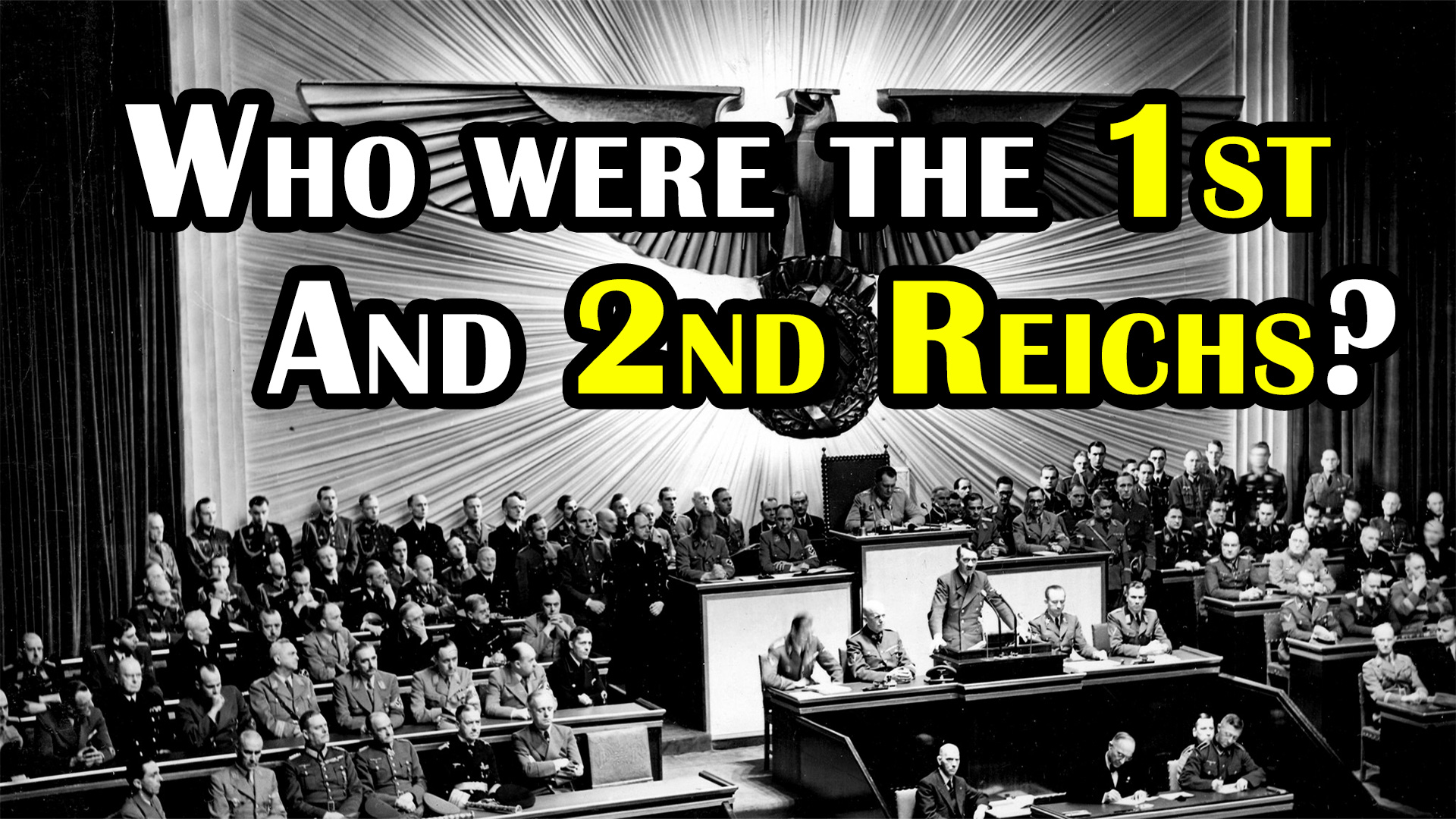
If Hitler’s Regime was the Third Riech, Who Were the First and Second?

Ever wonder why the Nazi dominion over Germany was called the “Third Reich” and who the first and second were? Well, wonder no more.

To begin with, the phrase “Third Reich” was first mentioned as the title of a book published by Arthur Moeller van den Bruck in 1923. As you might expect given the moniker for the regime caught on, the book was a hit with the far right in the region.

The author was a German cultural historian, who in the aftermath of the defeat of the First World War pondered the situation of the German nation and saw the newly established Weimar Republic with scepticism, as a non-natural entity. He wished for a more nationalistic solution. A revolution that would bring forth a German form of fascism, incorporating ideas of Nietzsche instead of those of Marx, to combine socialism with nationalism.

You’ll be further unsurprised from this description that this book had a huge influence on the Nazi party – which at the time was still in its early growing phase. Within his musings, Moeller more or less prophesied that a future ideal state with all German peoples (including Austria) would be the “Drittes Reich” in German, which we call the “Third Reich”. A more full translation however would be the “Third Empire”.

So what are those previous Empires, or Reichs? (And to prevent a flood of eye-rolling comments, the German plural of ‘Reich’ would actually be ‘Reiche’, but we’ll do as the English-speaking world does and simply add an ‘s’ to everything.)

As for the “ First Reich”, this refers to the Middle European Empire that began with Charlemagne in 800 CE. On paper, it lasted almost exactly 1000 years, to be precise until the abdication of Francis II of Austria in 1806 CE shortly after the defeat by Napoleon in the battle of Austerlitz. For careful viewers, this duration might already ring a bell, reminding them of the known Hitler proclamations of the “thousand-year Reich”. This exclamation is directly referring to this, later baptised as the “First Reich”, which as we will see served as a form of ideological background.

It is at this point we should mention that nobody except the Nazis called this the “First Riech”. The name by which it is called today is the “Holy Roman Empire of the German Nation”.

This medieval entity was not a typical kingdom, united by language and with an established capital and a sort of protoethnic homogeneity like one would find in say, France or England. Rather, while the Empire was indeed mainly Germanic, it incorporated many Italians and Slavic peoples as well.

The first stage was known as the Carolingian empire. The dominion of Charlemagne extended to an area so wide it hadn’t been seen in western Europe since the fall of the Western Roman Empire. He also aided the pope against an attack from Lombards. The pope – Leo III. – who was at the time rather upset at the Eastern Roman Empire (what we call Byzantium), decided to turn to this Germanic king for an alliance. Long story short, he crowned him a “Roman emperor”, which was an effort to symbolically revive the Western Roman Empire, in which the pope in Rome would play a major role. Despite this, contemporaries would call their kingdom the “Frankish Empire”, even until the 1100s.

Without going into much detail, for the following centuries, the organisation of this state was a loose confederation of states, overseen initially by the ruling monarch. The states each belonged to hereditary dynasties such as the Staufens and the Salians. This phase begins with the Othonian dynasty, most famous for King Otho I.,  to whose reign (according to some historians) the beginning of the German nation can be accredited. This is mainly referring to him convincing most germanic princes to unite under his banner to fend of the Magyars, at the  Battle of Lechfeld in 955 (near today’s Augsburg).

In the coming centuries until the early Renaissance, the grasp of the emperor which seemed at the beginning to be firm, began to gradually slip. This can be attributed firstly to the constant clashes for power with the pope, which undermined the authority of the emperor. The most famous clash ended in 1077 with the emperor Heinrich VI. being excommunicated and begging outside the pope’s castle at Canosa for forgiveness.

The second reason for the loss of control was the unruly nature of the smaller kingdoms within a vast empire.

From the 13th century onwards, the title of Emperor stopped being hereditary. He was instead elected, therefore being dubbed “electus Romanorum imperator”. The privilege of electing the monarch to be crowned by the pope lay with important bishops as well as princes aptly called prince-electors.

Fast-forward around the late 15th century and the full name “Holy Roman Empire of the German Nation” first appeared, as the territory was concentrated north of the alps in mainly German-speaking areas.

In the meantime, the power of the emperor continued to dwindle. The slow fragmentation intensified after the 30 Years War in the 1600s. At the same time, the kingship in other European powers such as France and Spain was being consolidated as an authoritarian institution (see Louis XIV, “L’état, c’ést moi.”), strengthening a sense of unity or common identity within these regions.

During the reign of Charles V, the empire then became fatally divided along religious lines in the aftermath of the protestant reformation. As Voltaire mentioned sarcastically, the “Holy Roman Empire” was neither Holy, nor Roman, nor even an Empire.

In the last phase of this “Empire”, the main power in the German world was beginning to split between the Prussians in the north and the Austrians in the south. In Prussia, the rulers were the prince-electors of the electorate of Brandenburg, the Hohenzollern, who were proclaimed kings of Prussia in 1701. Austria was led by the Habsburgs, who were to remain the last holders of the title (of emperor) until the end.

This end finally came with the dissolvement by the storm that was Napoleon who swept over the nations in the name of bringing revolution and with cries of “down with aristocracy”… while he simultaneously more or less tried to make himself an emperor.

This brings us to the 19th century when there was a big development in art that subsequently romanticized all medieval things. This genre of art was used in the formation of national ideologies, which in the center of Europe manifested in the desire to unite all German people into one country.

Fast-forwarding a bit more and the Holy Roman Empire was seen by the Nazis as the end of the anarchy of the warlords and the birth of a medieval form of German identity. As such, its strong leaders  were praised, although they had their problems with some aspects. For example Charlmagn killing Saxons by the thousands because of them being pagan allegedly nagging the Saxon-loving Hitler.

Nevertheless, in the scope of romanticizing the past, many of the old kings such as Barbarossa or the aforementioned Otho were portrayed as heroes of the German nation.

The heirlooms of these kings were seen as semi-sacred and were in fact politicized . Such as the famous crown of the empire and other regalia that were in Vienna, the seat of the last Holy Roman Emperors, which were brought to Nuremberg by the Nazis directly after the Anschluss (the taking over of Austria) in March of 1938.

Nuremberg was an embodiment of the old days, thanks to the aura of its medieval city center and ancient castle for one, but also due to the importance of the city itself. Nuremberg was one of the seats of the Imperial Diet (Reichstag) and one of the highest judicial institutions of the Holy Roman Empire (the Reichskammergericht). Also it lay conveniently almost at the center of the pre-war Nazi domain. And so it was chosen as a kind of center for mythicized ancient and modern German traditions- a sort of ideological capital. Therefore, it was home to the most glamorous Nazi party event- the Nurnberg rallies. The 1934 rally was filmed by Leni Riefenstahl, and made into a propaganda film called “Triumph des Willens” (“Triumph of the Will”), from which much of the nazi imagery that people know best comes from.

The imperial relics brought from Vienna, were displayed during the Party Congress of September 1938, six months after the Anschluss with Austria. These relics also included the Holy Lance, the spear that Longinus pierced Christ with, to which magical powers were (of course) ascribed. He who possessed it could not be defeated.

Unfortunately for the Nazis, nobody told the 3rd, 42nd and 45th infantry divisions which captured the city in April 1945, after fierce fighting.

Due to its symbolism, it was chosen by the allies as the place for the trials of the Nazi war crimes, the Nuremberg trials.

So yes, the Nazis cared a lot for what they called the “First Reich”, which, let’s not forget, was defeated by Napoleon in the end. Naturally, with the French at fault, it was yet another thing to go after them for.

This all brings us to the Second Reich.

Without looking too closely at the details, after a very tumultuous 19th century, in 1871, the king of Prussia – the most powerful of the German states – with the help of his generals and the cunning of his chancellor, Bismarck defeated the French under emperor Napoleon III. After this, whilst Paris was still under occupation, he was heralded Kaiser or Emperor of most of the German-speaking nations in­ Versaille.

Talk of a revival of the Holy Roman Empire was in the air. The mere act of naming the new country  “Deutsches Reich”, or “German Empire” was a reference to that. That old empire – brought down by the French – was now united again based on the occasion of defeating the French- and a Napoleon at that.

The most prominent example of the symbolism is the monument at Kyffhäuser (pronunciation: “Kif-Hoy-ser”), which is the third largest of its kind in Germany. Depicted in it is the solemn petrified king Barbarossa in his sleep, and atop of him, as if emerging from the rock, king Wilhelm the first is exiting as an incarnation of the prophecy and saviour of the country.

Despite all this, no one at this point thought of dubbing this empire the “Second Reich”. Yes, the regime did make parallels to the past, but they regarded themselves as a sovereign modern state. One prone to innovation, and not technically a second iteration of the Holy Roman Empire.

After its fall in 1918 however, many felt reminded of that period after Napoleon where they had been humbled by an external enemy and their German Empire dissolved. As previously alluded to, they began seeing the period in which they were living just as another interregnum, a period without a king. Essentially, the people – particularly those opposing the democratic system – were putting their hope in a future empire.

As van den Bruck put it, this “Third Reich” would be a continuation of the previous two, now both viewed as iterations of the destiny of German unity. This Third Reich would – unlike the Holy Roman empire or First Reich – be a truly sovereign one and – unlike the German Empire or Second Reich – inclusive of all German-speaking peoples. Therefore, it would include Austria and Bohemia (which was at the time in Czech). In the Nazi national hymn, “Deutschland über alles”, the area was explicitly mentioned, and the Third Reich should reign over a part of the world ranging from northern Italy (as seen today) to the Baltic and from the Netherlands to Esthonia.

So by dubbing themselves the Third Reich, the Nazis were Implying a natural continuation within German history, even a fulfilment of a prophecy. This also forged a link between themselves, the Holy Roman Empire and the German Empire. Of course, thankfully for everyone, including its own citizens, the Third Riech didn’t exactly have the staying power the Nazis had been hoping for.

If you liked this article, you might also enjoy our new popular podcast, The BrainFood Show (iTunes, Spotify, Google Play Music, Feed), as well as:

Expand for References

The post If Hitler’s Regime was the Third Riech, Who Were the First and Second? appeared first on Today I Found Out.


from Today I Found Out
by Nasser Ayash - July 01, 2022 at 05:35PM
Article provided by the producers of one of our Favorite YouTube Channels!
-

Thursday, June 30, 2022

How Did the Practice of Calling Liberals Left and Conservatives Right Start?

Depending on the country you live in, political opinion may be varied, or biased in one direction. In democratic countries, you obviously have the option to actually decide what direction your state should move towards via voting. And while a lot of political parties may opt for a safer middle ground usually more relatable for a wider demographic, there will always be the ones standing on, and for, the far right or far left.

But why do we call them that? It turns out the terms actually come with a rich history of their own and while they may mean different things in different countries and plenty of nuance on each side, a general classification comes from Scottish sociologist Robert Morrison MacIver, who in his 1947 treatise ‘The Web of Government’ classified things as such: “The right is always the party sector associated with the interests of the upper or dominant classes, the left the sector expressive of the lower economic or social classes, and the centre that of the middle classes. Historically this criterion seems acceptable. The conservative right has defended entrenched prerogatives, privileges and powers; the left has attacked them. The right has been more favorable to the aristocratic position, to the hierarchy of birth or of wealth; the left has fought for the equalization of advantage or of opportunity, for the claims of the less advantaged. Defence and attack have met, under democratic conditions, not in the name of class but in the name of principle; but the opposing principles have broadly corresponded to the interests of the different classes.”

Fascinatingly, despite seeming to be diametrically opposed on the surface, both sides of the political spectrum show manifestations of populism and may find a strong base in people belonging to each class of people from impoverished to rich.

In fact, there are proponents of the so-called ‘horseshoe theory’, which essentially says that the political far ‘left’ and far ‘right’ are, well, far closer to each other than they are to the ones traditionally holding the center. The reason for this is that the extremists on both sides tend to favour authoritarianism and totalitarianism.

In any event, this all brings us to the origin of the classifications “left” and ‘right-wing’ themselves. These lie in the French Revolution.

Rewinding to the turbulent years between 1789 and 1799, the French monarchy was, to oversimplify it, overthrown in favour of the common people’s plight.

With the king and all his friends now mostly having forcibly gone the way of their ancestors and therefore unable to voice any more opinions, a new system of government had to be implemented. This had to happen as quickly as possible, seeing as the alternative was a further descent into chaos, which was already pretty rampant in the region as is wont to happen when all the leaders get their heads lopped off suddenly and the mob takes control.

The ‘Ancient Régime’ or ‘Old Order’ played a quite vital role in this, as the general structure of legislative bodies was kept. Within it, from the Speaker’s point of view, who stood facing the assembly, it becomes clear where ‘left’ and ‘right’ comes from – it is simply the actual seating arrangement. Traditionally, as the more extremists on the two sides didn’t exactly like to co-mingle the aristocracy sat on the right while the commoners sat on the left and those more in the middle didn’t mind sitting closer. Naturally, within the National Assembly, being on the right came to mean supporting the king, while sitting on the left meant you were in favour of overthrowing him.

One member of this assembly, deputy Baron de Gauville summed up: “We began to recognize each other: those who were loyal to religion and the king took up positions to the right of the chair so as to avoid the shouts, oaths, and indecencies that enjoyed free rein in the opposing camp.”

These ‘commoners’ of the ‘opposing team’ were, however, not what we would understand of the term – people of more modest wealth and working regular jobs – but rather representatives of the richer capitalist class, the so-called ‘bourgeoisie’. Therefore originally, the ‘left’ was actually in favour of things like the free market and laissez-faire commerce. Within the parliaments, they also stood opposite those voicing their support for the aristocracy, the royals and their wishes, as well as the interests of the church. Unlike this original ‘right’, the ‘left’ wanted secularism, an increase of civil liberties, as well as republicanism.

Now all those we would actually call ‘commoners’ – the peasants, the working class, the unemployed – were not represented in this form of government really much at all, but it should be obvious that their ideals were in the general case in opposition to those of the aristocracy, therefore being ‘more left’ than the actual political left of the time. The bourgeoisie was still closer to what they wanted, and these early capitalists therefore the best allies they had.

So you can see how them gaining access to legislative bodies and the slow, but inevitable utter ousting of the aristocracy would shift the political spectrum towards capitalists being on the right.

Fast-forwarding a bit in history, to a time after 1848 – the parties used red and white flags as identifying symbols – and here is the origin of calling left-wing parties “the reds” (not to be confused with the phrase “raising red flags” which was a warning for floods).

The terminology of ‘left’ and ‘right’ was first used as a slur by the respective opposite parties and it was only in the early 20th century that these classifiers took over fully. Additionally, at first, political right-wing parties rejected the terms, as they did not wish to promote further disunity among citizens, while the ones on the left thought this was necessary in order to affect societal change. (Marx proclaimed a battle of the classes….And of course he needed classes for this theories to work!)

In any event, the formation of the more modern political parties closer to what we think of them as, finally, can be traced back to the 19th century, long after the French Revolution. The first of them emerged out of middle class liberals. The aristocracy disappeared for good in the 20th century, leaving only conservative parties that then had to compromise in order to gain a base of voters. Meanwhile, capitalism grew and with it the reactionary and equally multiplying working class, which began to form trade unions or identify with socialist, communist or even anarchist ideals.

Socialist parties originally held the purpose of giving political rights to workers and later split from the originally allied liberals, as they wanted said workers to actually have the control over the means of production. The colour red was adopted by many socialist parties, and is still seen in most european socialist parties today. It also became the colour of Communism as it developed out of WWI, in support of the Bolshevik Revolution.

On the opposite side of the spectrum, right-wing parties may include extreme conservatives, fascists, and nationalists. Depending on the time and place, these, too, either fall strongly into the people’s favour or out of it. Fascism, for instance, was obviously quite popular leading up to and during World War II in countries such as Germany or Italy, while being quite strongly condemned afterwards.

But to complete the political spectrum, another, mellower type of conservative party began to appear as a means to counteract liberalism – Christian democrats, who were originally founded by Catholics seeing a threat to their traditional values.

Finally, green parties with a strong stance on climate policies developed last and only recently, when the general public became aware of such issues in the late 20th century.

In any event, as you can see, since its original inception, the system of classifying everybody as left or right has obviously branched out, diversified with considerable nuance.

It should also be noted here that the development of what exactly ‘left’ and ‘right’ ended up meaning, did not happen in the same way in all countries.

For example, while some Americans may be quick to cry ‘communist’ at their Democrat party – which actually stands in part for so-called ‘libertarianism’ – modern-day French people would only scoff and call the same party ‘bourgeois’ instead. What is considered ‘left-wing’ in the United States is actually regarded as still pretty far on the right in some European countries. France and Germany’s respective political ‘left’, for instance, are on the side of socialism.

Additionally, it has been argued that ‘left’ and ‘right’ cannot properly encompass where one stands on most issues, as the political landscape is complex and includes many social and economic factors. While there are many ways of detailing this, one widely influential way of expressing this complexity was conceived by Hans Eysenck in the 1950s: He applied two axes, ‘radical’ to ‘conservative’ and ‘democratic’ to ‘authoritarian’, based on his (sometimes contested) research.

Another helpful two-axis system stems from Virginia Postrel, who in 1998 expanded the economic left-right axis with one ranging from authoritarianism to libertarianism.

And because it has grown into a field of study easily as varied as the political fractions, many more examples could be given, all with their own virtues and flaws. However, in most countries, ‘left’ and ‘right’ are still the clearest signifiers of which hill one is prepared to die on.

If you like this article, you may also enjoy:

Expand for References

The post How Did the Practice of Calling Liberals Left and Conservatives Right Start? appeared first on Today I Found Out.


from Today I Found Out
by Nasser Ayash - June 30, 2022 at 05:00PM
Article provided by the producers of one of our Favorite YouTube Channels!
-

Saturday, June 18, 2022

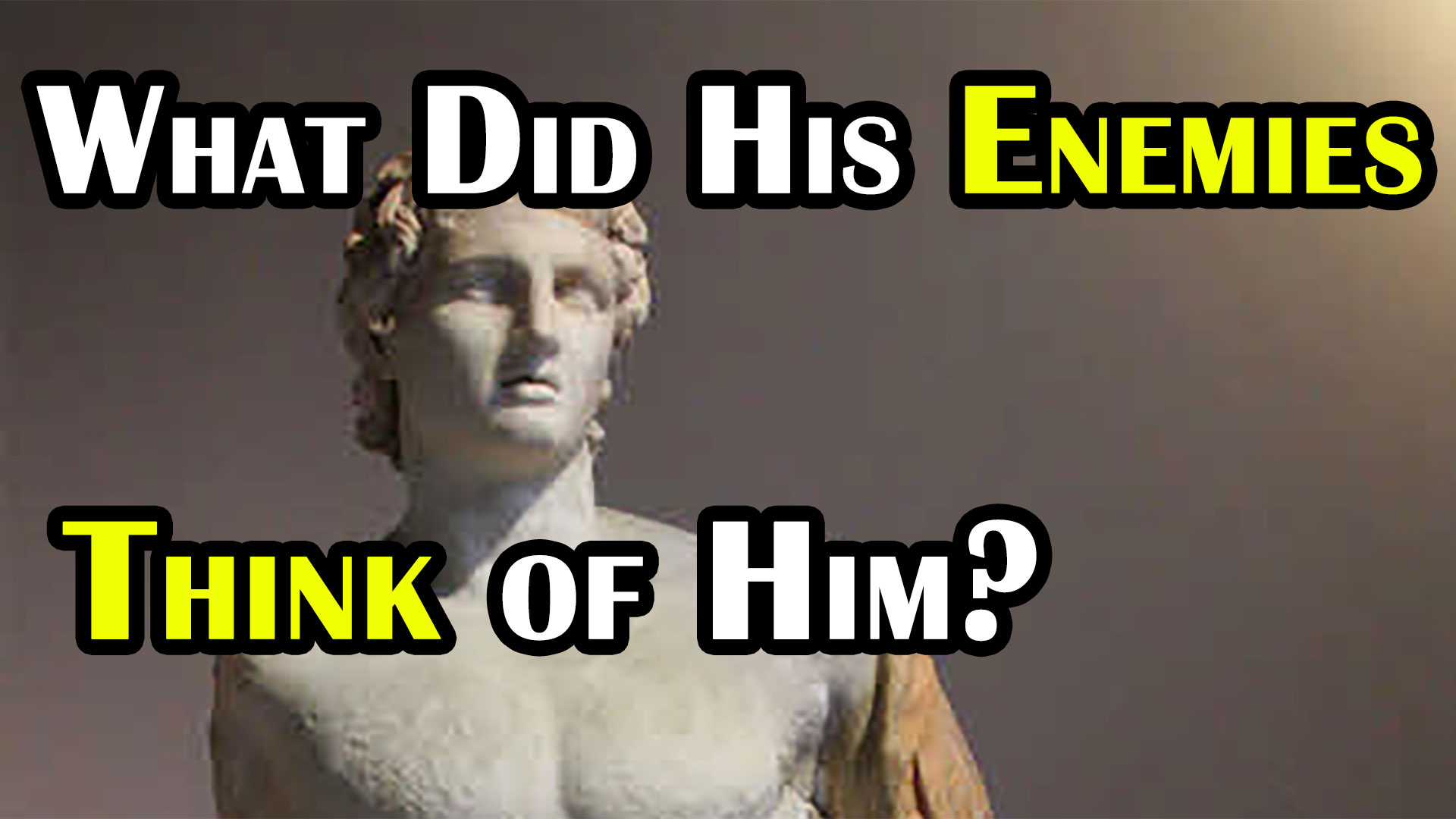
How do The Persians Teach Alexander the Great and When Did He First Become “Great”?

We’ve all heard of him. Alexander the Great has been for many centuries a household name in much of the world- an impressive feat for a king who’s been dead for two millenia and reigned only for a little over a decade.

In western countries, his defeat of the Persian Empire in the 320s BC has often been depicted as bringing culture to barbarian lands. And thus, the events of his life are put in a context of the clash between East and West.

As you can imagine, however, there is another side to the story and indeed, to history: the one of the defeated Persians. And if you have seen our video on how the Crusades are taught in these regions, we are always interested in discussing what a historical event we might know from one point of view looked like from the other side.  So how do the defeated peoples view Alexander and who first called him “Great” anyway?

To begin with a little background to his “greatness”- as king Alexander III of Macedon, Alexander ruled from 336 to 323 BC. He was born as the son of king Philipp II, came into power when he was 20 years old, and died thirteen years later as a living legend, undefeated in battle but brought to heel only by an unidentified sickness.

During his short reign, he managed the unthinkable: Not only did he secure the unity of the Greek nations under his banner, but he also went on to begin a streak of conquests so successful, the world would arguably never see their like again – though not for lack of trying. In fact, despite many anecdotes highlighting different aspects of his character – such as cutting the unsolvable Gordian knot – Alexander might be best-known for being a major role-model for a huge number of significant historical figures that came after.

Not just admired after death, generally the first in line of battle, he was reportedly loved by the soldiers and heralded as an example of excellent leadership. From his practice of literally leading his men into battle, unsurprisingly, he was almost killed countless times and regularly got injured trying to imitate his personal hero, Achilles. One of many examples of this comes from the siege of a Malian city along the Indus river in the winter of 325, when Alexander grabbed a ladder and led his men up it himself. The ladder broke and he found himself alone on top of a wall. Instead of jumping back down to safety, he dove inside the city with only two comrades. Somehow, he survived the ordeal, walking away with nothing but an arrow in the chest. Naturally, his comrades and even enemy were impressed at his boldness and courage.

For his people, who had their entire world established around the shores of the east Mediterranean, the experience of reaching lands previously unheard of  – up to the Indus river! – seemed like a mythical experience happening in their lifetime. The very fact that Alexander’s military achievements surpassed anything the Greeks had hitherto known also made a big difference in propelling him to godhood.

This went right down to performing miracles, like reports of the sea retreating to let him pass through near Phaselis or being greeted as the son of Ammon-Zeus by priests in Egypt. In other instances, he was shown to even surpass other gods, for example during the attack on the Aornos fortress that according to legend, even Heracles could not conquer.

The worship of Alexander is a complex phenomenon. Although it was based on an existing tradition, it still differs from both his immediate predecessors and later developments. His cult was established in many cities in Asia Minor, probably already during his campaign in response to his achievements and his benefactions.

An important difference from the cult of both earlier mortals and that of later kings is the wide diffusion, popularity and persistence of Alexander’s worship, which in some places lasted until the Christian era.

Moving on from his boldness, Alexander was also a savvy politician. The attack on the Persians was strongly portrayed as Just Vengeance of the Greek Peoples (of whom Alexander was declaring himself leader) in response to the Persian attacks of Xerxes and Darius against Greece 150 years earlier. These were the Persian Wars of 490 to 479 BC with the whole big fuss about Marathon and “this is Sparta”, which were very traumatizing for the Greek subconscious. Thus, by getting revenge for this, he helped unite these groups under his banner.

Alexander’s revenge policy culminated in perhaps the most hideous act Alexander the Great committed during his illustrious career, a deed he allegedly regretted after the fact: Namely, the burning of Persepolis, the symbolic capital and sacred ground of the Persian kings.

By ancient historians, it was regarded as a political act, a sort of “mission accomplished” move in direct vengeful parallel to the burning of Athens by Xerxes in 480 BC. In an effort to remove the blame from Alexander, some also accuse an Athenian girl of having proposed this during the feast, with the troops burning the ancient city under the influence of alcohol, and with sobriety came Alexander’s regret. Of course, it is very convenient that gold and other valuables were removed from the city first in a very orderly, non-drunken fashion in preparation for the destruction…

Another thing to chalk up to earning the “Great” moniker was his pivotal role is the formation of the so-called Hellenistic World, which now consisted of all of the eastern Mediterranean, including Egypt and Syria. These regions, although holding on to their traditional values (see the maccabees) participated in the new Greek and later Roman civilization and helped in the distribution of historically significant ideas and even religion.

 Unsurprisingly, conquering the known and partially unknown world in a series of victories that stretch from the Danube to the Punjab and the Indus river without being defeated once, all the while living life to the fullest- fighting by day and partying at night- until his sudden death – all between the age of 20 and 33, won him the epithet ‘the Great’.

However, it wasn’t the Greeks that came up with the moniker, but the Romans, as the first known historian to call him that was Quintus Curtius Rufus, a 1st century AD historian. And the earliest mention we have of Alexander Magnus (‘the Great’ in Latin) is in a play written by Titus Maccius Plautus around 200 BC, so more than a hundred years after the death of Alexander.

But the name stuck and is an indicator of the Alexander hype having reached the young and growing Roman Empire. On the note, many historically significant imitators came after, such as the Roman general Pompey the Great, who not only adopted the same epithet ‘Magnus’ but also Alexander’s hairdo. He also imitated Alexander in other aspects of his life, such as the friendly attitude towards his subordinates or his habit of naming cities after himself- a fact still visible in places like Pablona, Spain, which comes from  Pompeiopolis, the camp of Pompeius during the civil war against Sartorius, around 75 BC.

In his biography of Caesar, Plutarch also states that when Caesar was reading from the history of Alexander, he burst into tears realizing he could never accomplish what Alexander had accomplished by the age of 33.

Moving on from there, Octavian, the future first emperor Augustus, visited Alexandria in 31 BC after defeating Cleopatra. There, Suetonius informs us, he made a great deal out of honoring Alexander’s grave by reverently placing a golden crown there. When his guides asked if he would also like to view other important tombs of the Ptolemies – the last Pharaohs – he abruptly dismissed the suggestion by saying that ‘he came because he wanted to see a king, not dead men”.

(In Latin: “regem se voluisse ait videre, non mortuos” – Suetonius,  Augustus. 18)

But that’s the western perspective- how was Alexander perceived and taught by the people he conquered and those in the region that came after?

To begin with, very quickly following Alexander’s conquest, some of the Persians regrouped to form the Parthian empire – more or less around today’s Iran – then bordering the Hellenistic world and its later Roman successors to their west. From their point of view, they did not necessarily distinguish between the terms Greek kingdoms and Roman empire, as to their eyes these two belonged to the same cultural group.

In 224 AD, a revolution brought a change in the name and attitude of the empire. Namely it saw the rise of what would become the archnemesis of the Roman empire: the Sassanids. Their policy was a conscious callback to the good old days and aimed to revive the glory of the Achaemenid empire – the one that Alexander conquered over 500 years prior – implying their intention to reclaim all the lands that were once part of said empire and which now lay deep within the Roman domain.

The Sassanids’ declared maxim could be seen in all forms of expression, as a renaissance of Achaemenid art and style. Even archaism in language was all around. To understand this anachronistic tendency, imagine an English person walking around downtown Manhattan in colonial clothes and speaking Shakespearean English. He’s either a history geek cosplayer, or… he’s up to something. Now imagine a whole culture doing this.

Some of the things the Sassanids revived would remain very important elements in Eastern symbols, such as the crescent moon and star, then reappearing on coins and monuments as elements of the Sassanid king’s crown.

A common theme that emerged was that the valuable centers of their religion were destroyed by the troops of Alexander the Great. Tales of Alexander paying respects to the founder of the Achaemenids, king Cyrus, or other noble behavior meant little for the Magi – the Zoroastrian priesthood – for whom the destruction was nothing short of a calamity. And according to the Iranians, the desolation did not just extend to the temples but had also ravaged sacred scripture as well. The Avesta, the holy book of Zoroastrianism, was said to have been lost in the destruction of Persepolis.

From the early Sassanid period onwards, Alexander is referred to by the epithet gujastak in Persian literature, meaning “accursed”. A famous book stemming from around the 3rd or 4th Century, Ardaviraf-Namak, tells of a valuable copy of the Avesta in the Achaemenid archives in Persepolis that was destroyed by “Alexander of the Romans“ (as alluded to, Roman and Greek were regarded as the same.)

From their side, an ideological spearpoint was – similar to propaganda Alexander himself had used to get revenge upon the Persians- the idea of vengeance; seeking to rectify the sacrilege of Alexander who had burned Persepolis and destroyed the sacred texts of Ahura mazda, the sacred Avestas.

From the Roman side, clashes with the Parthians had become routine, but now, suddenly… it became an ideological matter.

This was quickly felt from Ardashir and Shapur, the first two rulers of the Sassanids,  infamous to the Romans as a constant threat. They even managed to capture the Roman Emperor Valerian in 260 AD, who thus became the first Roman emperor to be taken as a prisoner of war, causing shockwaves in the Roman world.

All of this came with an unexpected benefit, however. In early medieval times, many works of literature and science were lost due to the decayed interest in things that were not purely about praising the emperor or dealing with religious matters.

A main way much of the ancient knowledge was saved, was a trend of translating Latin and Greek authors to Middle Persian and later into Arabic. The beginning of this trend has a surprising link to the propaganda against Alexander the Great.

A first systematic interest in translations of works of scientists and philosophers in the Middle East can be traced back to the time of the Sassanid Persian Empire. The Sassanid ideology up to the 6th century AD emphasized the superiority of the Persian tradition, and explained the advances of other rival states – such as the East Roman Empire (Byzantium) – as knowledge scattered from ancient Persia. Namely, they accused Alexander the Great of stealing the ancient Persian knowledge from the palatial library – where the sacred books were kept – to the later benefit of the Greeks.

This rhetoric was linked with the ties that the Sassanids tried to form to Achaemenid Persia and was useful politically during the constant conflicts with the Roman and Byzantine Empires.

This way, the Sassanids saw themselves as guardians of the ancient knowledge that was returning from Roman territory to the Middle East, where according to their view, it had initially originated. Thus a nationalistic propaganda that actually saved books for a change!

This transfer often happened in the form of books brought by Nestorian refugees, former citizens of the Roman and Byzantine Empire, who established schools within the Sassanid Persian Empire, for example in Jundishapur, where they were involved mainly in medicine but also dealt with other philosophical subjects. (This trend would continue later by the Arabic-speaking Abbasid dynasties.)

But what about Iran today? What do they think of Alexander and his supposed greatness? Does it follow their Sassanid predecessors in the criticism of Alexander? Well, yes and no.

Alexander of Macedon is again portrayed as the destroyer of their ancient empire, but since other parts of their history are far more focused on for political or religious reasons, these events are not typically greatly discussed in the education system.

One of the reasons is that the revival of the nationalistic Persian pride around the Achaemenid empire was undertaken by the Shah of Persia, the one that the Iranian Islamic revolution of 1979 overthrew.

In 1967, he had taken the title Shah-en-shah, or ‘King of Kings’ that the ancient Persian kings had carried before. As part of his efforts to modernise Iran and give the Iranian people a non-Islamic identity, he began the effort to celebrate Iranian history before the Arab conquest. An effort culminating in the celebrations at Persepolis in 1971 for the 2500th anniversary of the coronation of Cyrus the Great, the first Achaemenid king. This celebration was criticized by Khomeini and his followers who would later found the islamic republic, and who called it the “Devil’s Festival”.

So, in the end here, it is not like the Achaemenid Empire has disappeared from the national identity – far from it. But it is not necessarily in the foreground, as the Islamic republic has other things they want to focus on.

More specifically, in the modern Iranian standard school books, Alexander does appear somewhat prominently in three subjects.

The first reference comes from the Social Studies textbook taught in primary years, which include the discussion of Iran’s historical sites, including Persepolis. Alexander’s successors in Persia and the dissemination of Greek customs and language are mentioned, but the expedition itself, its battles, or even the burning of Persepolis is completely missing.

In the 7th grade (so concerning around 12-year-olds) the Persian empire is presented analytically and so is the invasion of Greece, but no mention is given to the burning of Athens. Here the invasion of Alexander is described in some detail.

It is similarly treated within the 4th grade of secondary education (age 15).

As Fatima Faridi Majid noted, “In all, the Iranian books do not report the destructions in Greece such as the burning of Athens, although they admit the weakness of the Achaemenids, to which they ascribe Alexander’s conquests, and also mention the burning of Persepolis and other cities more than once. For Iranians, the Persian Wars and Alexander’s conquest of Persia are generally seen as short interludes in their long, turbulent history.”

Therefore, Alexander’s deeds are seen as an act of foregn infiltration, but it is not as big an issue as, say, the Crusades. As other issues have become prevalent, it is no longer as important as it was for their ancestors, the Sassanids.

Of course, the negative depictions are not necessarily representative of the Alexander tradition, as he was integrated into myths and legends of various peoples, as a semi-mythical king or personality.

And so, even in Persia, the mythical aspect prevailed. This is best seen in the Persian 11th century poet Farrukhi Sistani, in the introduction of some Alexander stories:

“The acts of Sikander (Alexander),

The tale of his exploits and of where he went

Have so much been heard by men wide and far,

His story now is known to all by heart.”

As Mendeghi in a 2018 article mentions, “To give an example of the popularity of Alexander’s story in the Persian tradition, it is worth mentioning that in Khāqānī’s twelfth-century Dīvāns and Farrukhī’s and ‘Unṣurī’s eleventh-century Dīvāns alone, Alexander and his deeds are mentioned more than 30 times.”

One of the most important works of literature of the Persian language, the 11th century epic Shahnameh (“The Book of Kings”) by Firdausi includes Alexander in a line of legitimate Persian shahs, a mythical figure who explored the far reaches of the world in search of the Fountain of Youth.

The trend of connecting mythical elements with Alexander began soon after his death. One such example is that when Lysander, a general of his, heard a story in his late years that Alexander had met with the queen of the Amazons, he ironically answered, “and where was I during this?”

Contemporary philosophers noticed the increasing mythical elements of the historical occurrences of Alexander, in both high and popular literature. Some were smart enough to recognize that they were witnessing the birth of legends and future myths.

One of these was the philosopher Euhemerus, who asserted that the origin of the Greek gods was likely similar, and that must have been kings or benefactors to the people, who had thus earned a claim to the veneration of their subjects. His most extreme  example was that the highest Greek god, Zeus, was originally a king of Crete, who had been a great conqueror. This rationalizing method of interpretation is named after this philosopher and now known as “euhemerism” and is considered one of the first schools of atheism.

In the end, Alexander the Great does in many ways live up to his epithet, as the prime example of how a historical personality can inspire numerous generations across several cultures and in the end continued to change history in significant ways long after his death owing to his many imitators who sought to mimic and outdo their idol.

If you liked this article, you might also enjoy our new popular podcast, The BrainFood Show (iTunes, Spotify, Google Play Music, Feed), as well as:

Expand for References

https://ift.tt/cWbVCA2

https://ift.tt/dWwVyqH

https://ift.tt/y4ZzL23

https://ift.tt/X7O5gsU

https://ift.tt/V0Xy3Lb

Majid, Fatemeh-Koutlaki, Sofia. 2016. One Event, Two Readings: A look at Alexander’s Expedition to Iran in Iranian and Greek History Books

Manteghi, H. (2018). Introduction. In Alexander the Great in the Persian Tradition: History, Myth and Legend in Medieval Iran (pp. 1–9). London • New York: I.B.Tauris. Retrieved December 19, 2020, from https://ift.tt/diesZpj

The post How do The Persians Teach Alexander the Great and When Did He First Become “Great”? appeared first on Today I Found Out.


from Today I Found Out
by Nasser Ayash - June 18, 2022 at 03:06AM
Article provided by the producers of one of our Favorite YouTube Channels!
-

Is It Actually Possible to Inherit Someone Else’s Debts?

Inheriting is rarely as fun as films and books would have you believe. Instead of a previously unknown great-aunt who just so happens to deem you the sole heir to her surprisingly large fortune, it usually comes with the death of a close relative and more often than not, strife among the surviving parties.

The age-old ‘motive for murder’ trope aside, if you do have a tidy sum of money and several potential heirs, they are likely to either begrudge each other part of your fortune – finding arbitrary factors to determine who might deserve more than the other. If your family is hideous to begin with, leaving all your money to an unsuspecting and unrelated caretaker á ‘Knives Out’ may be the best option, but no one can claim that was a smooth ride either.

Even if the matter is clear and children and grandchildren are beloved, it isn’t as easy as just reading the will. The bureaucratic hurdles standing between heir and inheritance are sometimes immense, annoying and often take a decent chunk of what was left.

But what if you were not only broke when you die, but still owe money to creditors? Is all debt forfeit the minute your heart stops beating or are you merely passing it on to your unsuspecting children?

 To begin with, here’s what normally happens when you die. Depending on your current religious affiliation, your soul may be judged by Anubis, or you may even be conscripted to kick an endless amount of ass for the glory of Odin in Valhalla… Also, FYI, there is a good chance your body back on Earth will poop itself spectacularly… For an in depth look at this, see our video Do People Really Defecate After Death?

But as to your assets, if there’s a last will and testament, the case seems relatively simple. Heirs or beneficiaries are designated prior to death and documentation notarized, so that it is clearly and unmistakably stated who is to inherit what. The ‘what’ may include money, but also real estate or even stocks. In the case that the assets are not individually listed and attributed to specific people, a fight to the death between all named beneficiaries is the only option. Or all the assets are simply distributed evenly, which may or may not kick off an epic legal battle if someone in the chain is unhappy about this.

In order to kick-start the arduous process of inheriting, the will has to be submitted to the probate court, which then authorizes an executor. Only then can assets officially start moving to the heirs. Additionally, there may be restrictions to the inheritance, such as a sum of money only being paid bit by bit in small amounts per year or allocated to paying for higher education.

If there is no will, it’s significantly more complicated and can therefore take months or even years for the matter to be settled. Perhaps the most famous instance of this was the case of Howard Hughes, whose lack of will resulted in countless legal battles spanning all the way up to 2010- 34 years after his death.

In the case of no will, it is still the probate court who has to deal with the questions at hand, but they now have the dubious pleasure of having to determine what the deceased would have wanted and check all assets for possibly coming with an already named and attached beneficiary. This may be the case for bank accounts and retirement plans, but jewellery and other assorted heirlooms are even more difficult to allocate. Needless to say, some patience is required, and the existence of a will is vastly preferred.

This brings us to debts. As to whether or not debt can be inherited, the answer lies somewhere in between. In the vast majority of cases, no, in modern times at least, your children will not have to pay off your bills for the rest of their days, cursing your existence between the three jobs it takes to both take care of their families and to make enough to satisfy your creditors. But the debt also doesn’t suddenly disappear entirely.

First, one needs to distinguish between a secured and an unsecured debt. A secured debt means that certain assets are put forth upfront to balance the loan taken. For example, a piece of land may be set as security for a newly acquired house. If the debtor dies before the loan is paid off, the aforementioned asset – the land – is seized and taken to settle the debt.

An unsecured debt is one accrued without anything in particular given as a security asset. In this case what happens is that your estates are used to pay off your debt. That means that if you own any sort of property, be it house, farmland or just a neat assortment of IKEA furniture, your creditors can now feel free to cash in on as much of them as equals the sum of your debt.

Now, depending on just how much that antique stamp collection is worth, the actual total of your debt may be paid off with some to spare for your spouse and children. Should the debts you have accrued during your lifetime surpass the worth of laptop, printer and tv, any and all savings, and everything else you once called your own, your heirs are clearly safe.

On this note, debts actually have priorities. Tax debts are so-called primary debts, which means they have priority and are the first things to be paid off out of a deceased person’s belongings. Yes, even after death, the taxman will always make sure he gets his cut of your life’s efforts before anyone else.

Unpaid credit cards or personal loan debts on the other hand are considered secondary and need to wait until the primary debts are settled. Meaning, they’re the ones who have to hope there’s enough for everyone to go around.

In the same vein mortgages – which, by the way, are called “death pledges” for the fact that the deal dies if the agreed amount is paid or the payment fails – may be saved by life insurance. If not, the property the mortgage is taken on is forfeit and may be sold by the creditors.

The rest of the debt needs to be forgiven – not gladly, one may assume – after all assets have been liquidized.

But is it impossible to pass on debt? To begin with, if you really, really want to – or merely wish for your estates to remain untouched and inheritable – there is a potential way. And yes, at first glance this may seem like the perfect revenge to screw over those ungrateful brats who never visited unless they wanted something, or the spouse who’s been cheating on you for the past thirty years and no doubt had a hand in your death.

In your will, you may name a person further responsible for your debt. If this was put into writing and notarized during your lifetime, there is no escape for that person; creditors can sue them for the rest of your debt.

‘Hah!’, you may think, in that case, how about naming an old rival as your heir? The boss who’s always treated you terribly? Or one of the super rich to whom your measly debts will at the most seem like a singular fruit fly?

Unfortunately for those who want their first act in death to screw someone over, it doesn’t quite work like that. Yes, the person to accept the debt may be named in the will, but you also need that person’s written and notarized agreement that they will take it on in case of your death.

Moving on from there, there are some debts that – no matter how hard you may want it to go differently – will pass on to the remaining family. This is the case for medical bills and nursing home costs. Even if a person dies in surgery, the bills for the operation and the rest of the hospital stay will arrive sooner rather than later. This is obviously not always the case in countries with a different health care system than the US, where going to the hospital for a mild painkiller prescription and a couple of stitches is sure to bankrupt your family regardless.

That said as with other debts, if the deceased’s assets cover the accumulated medical costs, they will be used to pay them up, but if this is not the case, the children will have a hefty debt on their hands that people might come knocking about. This is called ‘filial responsibility’ and is more or less the legal way of proceeding in 30 US states. However, the wording is ambiguous and it doesn’t get enforced in every case.

Additionally, debt may be inherited if someone else is equally responsible for it. This is the case if the loan was taken out under a joint bank account – so your spouse may not be home free after all, even if they are not the one who made the loan agreement – or someone co-signed the debt arrangement. People living together are also not safe from needing to pay off rent array debts, nor do the persons in question get out of a shared bill.

And what about the usually not-so-insignificant costs of the funeral? In short, no one is obliged to pay for a funeral, but the next of kin is allowed to use the deceased’s property before anyone else if it is to pay for funeral costs.

Now all of this comes with the caveat of only applying to the US and the UK. In other countries, the law may vary quite a lot.

Here’s a fun example from Poland. Zuzia, an 11-year-old girl, made headlines and opened room for talk about the controversy about the proceedings in the case of inherited debt. After her father’s death, the debt of a million zloty – which equals about 235,000 euros or 270.000 dollars and was taken out as a loan to expand his construction supplies warehouse – passed to her and was enforced by the bailiff of a debt collection agency, who we hope at least didn’t stoop to directly saying to her, “Give me all your lunch money kid!”

Lawyer Tomasz Parol from the ‘Angeli Iustitia’ foundation said on this topic, “When debt collection agencies around the world acquire claims, they must verify whether they are enforceable. In Poland that’s not the case, since such agencies can get away with more to settle claims.” In 2016, the law was changed to also only having to pay off inherited debts via the estate left.

In South Asian countries such as India or Pakistan, debt may in the past have been taken over by family members, which lead to bonded labour sometimes lasting generations. In India, this system was – at least officially – abolished in  1976 through the ‘Bonded Labor System Act’.

Japan and other countries, such as EU members like Romania meanwhile have the clause of being able to simply renounce your inheritance if debt is higher than the assets. And in theory, this does sound like a good plan; it isn’t too appealing to wholeheartedly accept acquiring debt. However, this means also having to pass up any and all items of sentimental value as only accepting part of the inheritance is impossible.

And if you make a will that leaves, say, the grandfather clock that has been in your family for three generations to your son and your debts to a former friend turned nemesis, that backstabbing bastard can simply renounce the inheritance and the debt passes to your son nonetheless, who then once more stands before the problem of either inheriting debt and assets alike or declining all of it.

Finally, if you ever wondered how ancient civilisations dealt with this matter, well, especially in wealthy societies where much wealth but also much debt could be accumulated, its inheritance was important. If we take Rome as an example, normally the inheritors could choose if they accept the inheritance. Including debts and everything. It is known for example that the emperor Hadrian relieved a person who had accepted an inheritance, and afterwards discovered that it was incumbered with a heavy debt.

Later this was codified so that no misunderstandings occurred, leading to the legislation of Justinian. This legal code freed the heirs, who accepted a “hereditas”, from all the debts and obligations, beyond what the property would satisfy, provided he made out an inventory (inventarium) of the property in a certain form and within a given time to report all assets. If this reminds you of the American system, it’s not by accident…

If you liked this article, you might also enjoy our new popular podcast, The BrainFood Show (iTunes, Spotify, Google Play Music, Feed), as well as:

Expand for References

The post Is It Actually Possible to Inherit Someone Else’s Debts? appeared first on Today I Found Out.


from Today I Found Out
by Nasser Ayash - June 18, 2022 at 02:53AM
Article provided by the producers of one of our Favorite YouTube Channels!
-

Wednesday, June 16, 2021

That Time a Farmer was Given Ultimate Power Twice and Changed the World Forever By Walking Away Both Times

The subject of what a political leader in a democracy does after his term has ended and the merits of gracefully resigning from power has been on the news recently.

Enter the subject of today’s story which takes place in ancient Rome, at the dawn of the Republic Era. The person in question was Cincinnatus, whose actions in terms of political ethics not only shaped the political life of generations to come, but was linked with the essence of what democratical thinking is, so much so that founders of the American nation dubbed Washington with Cincinnatus’ name. So who was Cincinnatus and what made him rather unique compared to the vast majority of his political leader compatriots throughout history?

Lucius Quinctius Cincinnatus was born to the noble house Quinctii possibly around 519 B.C during the last years of the Kingdom of Rome. This means he belonged to the first generation to be raised within the just recently established grand experiment that was the Roman Republic.

In the 460s, Rome was in turmoil, with the main issue being the representation of the plebeians in government – those of its citizens not born to noble families. At one of the violent clashes, one of the two serving consuls, Publius Valerius Publicola, was killed. Cincinnatus rose to his position as replacement via a system vaguely similar to how a vice president can replace the president in the United States.

Cincinnatus therefore served a term in the highest political office in Rome. Ultimately, however, rather try to cling to power like so many others, he eventually chose to return to his private life. This was at the least unusual for various reasons. For one thing, he did not step down because he was fed up with politics. Far from it: He was highly opinionated regarding the issues of his day, with a strong stance against the plebeian demands for constitutional changes that would allow them to circumscribe the decisions of the consuls.

Furthermore, he was in a very difficult financial situation because of a fine he had to pay on account of his son Caeso, who – after causing political turmoil and violence – left the city before the court had reached a sentence. In the end, Cincinnatus had to pay a rather large fine in his stead, for which he had to sell his estate and instead live on a small farm across the Tiber (possibly around the Trastevere Region of Rome today). Thus, by stepping away he not only gave up incredible powe, but also was returning to the life, not so much as a wealthy noble as he had been before his term in office, but rather the life of a simple farmer.

While this all did nothing to advance his personal fortunes, his choice not to use his term as consul as means to broaden his political career, change his economic fortune or even to recall his son whom the republic had condemned, gained him the respect of his fellow Romans.

But the story of Cincinnatus was just beginning. Two years later, around 458 BC, Rome was once more in peril, as the army of the neighbouring nation of Aequi broke towards Rome, defeating one consular army while the other was far from the action.

To respond to this eminent threat, the senate decided to elect a dictator, which at that time was a title provided by the senate to a person who would have king-like powers for a fixed term: six months, after which the power would be returned to the senate. This enabled the appointed dictator to act swiftly, without asking for permission or waiting for the conclusion of further – and often extended – senatorial debates.

Naturally the person chosen for this role had to not only be imminently capable, but also trusted to actually step away when the term was finished. Thus, for this role, the senate chose Cincinnatus.

The historian Livy illustrates the scene. A group of senators approached the farm where Cincinnatus was working. He greeted them and asked if everything was in order. “It might turn out well for both you and your country,” they replied, and asked him to wear his senatorial toga before they spoke further. After he donned the garb of the office, they informed him of the senate’s mandate, hailed him as dictator and took him with them back to Rome.

Cincinnatus then got right to work mobilising the army, besieged the enemy at the Battle of Mount Algidus and returned victorious to Rome- all this in a span of two weeks.

After this huge success, all possible political exploits could have been available to him, especially as he was constitutionally allowed to stay in power for five and a half more months. Despite this, upon his return, he immediately abdicated and returned to his farm. The task at hand was complete, thus he saw no reason power shouldn’t be returned to the Senate.

Twice he could have used his position for his own gain, and twice he had not only chosen not to, but stepped away when his work was complete. But this isn’t the end of Cincinnatus’ tale.

Nineteen years later, in 439 BC, Cincinnatus was around 80 years old and once again asked to become dictator, this time to deal with inner political intrigue, as a certain Maelius was using his money to try to be crowned king – the ultimate threat against any republic. The episode ended with the death of the would-be king and again, his work done, Cincinnatus resigned after having served less than a month as dictator in this instance.

As you might expect from all of this, these practically unprecedented actions by a leader granted infinite power made his name synonymous with civic virtue, humility, and modesty. And they serve as an example of caring about the greater good.


To understand the importance of these actions one needs to zoom out and evaluate the time period in which they happened.

At the time, the system ‘republic’ was a novel occurrence in world history, to outsiders not necessarily different from a weird type of oligarchy. Furthermore, except for some initial reactions from the Etruscans directly after the founding of the Republic, the system, which dictates that the city leads itself, was not really put to the test. It would have been completely understandable if given the first opportunity, the city had turned back to a typical king-like government. The existence of a charismatic leader like Cincinnatus could easily be the catalyst to usher in the return to the era of kings, if the incredibly popular Cincinnatus was inclined to take the power. Yet he chose not to even after being granted ultimate authority twice.

This was crucial, as these events happened during the second generation of the Republic. And it was the deeds of the second and third generation after the founding of the Republic that were the ones that truly solidified the belief and generational tradition of the system which would come to be one of the most influential in human history. One can easily see how had Cincinnatus chosen to exploit his position and his popularity as the vast majority of world leaders have done throughout history, history itself as we know it might have been vastly different.

If you liked this article, you might also enjoy our new popular podcast, The BrainFood Show (iTunes, Spotify, Google Play Music, Feed), as well as:

Bonus Facts:

Cincinnatus as a role model had many imitators throughout time – some more successful than others.

Sulla

Continuing with Rome, during the Late Republic, the political Sulla was, let’s say… controversial to say the least. You know that retired authoritarian navy seals commander from any movie? Well, multiply this by ten, add some crazy slaughtering frenzies and there you have it. However, in 79 BC, after putting order to the Roman empire, and having been dictator since 81 BC, he resigned.

His supporters would like to compare this to Cincinnatus, but it is a rather different situation, seeing as he did not step down to resume a simple life, but rather to write his memoirs in a fancy resort. Plutarch states that he retired to a life of luxury, where, “He consorted with actresses, harpists, and theatrical people, drinking with them on couches all day long”. So rather than stepping down to a simple life, more of a retirement package filled with partying and bliss without the cares, intrigue, and dangers that come with being dictator of Rome.

In another contrast, his reforms did not ultimately make the impact he had hoped and their results were completely thrown over after his death, with the Empire being founded just a few decades after.

Diocletian

Another controversial Roman leader – now in the not-so-brand-new empire edition – marks Diocletian. Ruling as emperor from 284 to 305 AD, Diocletian achieved what few did during the so-called ‘Crisis of the Third Century’; he not only survived long enough to establish political reforms, but actually managed to stabilize the empire for the time being. In 305, he did what no Roman emperor had done before; he abdicated voluntarily and retreated to his palace on the Dalmatian coast – now the historic core of modern day Croatia’s city Split – where he famously tended to his vegetable gardens.

Not even lasting the duration of his retirement until his death in 311 AD, Diocletian’s established tetrarchy – the splitting of the empire among four rulers – collapsed into renewed chaos, and in 308, he was asked to return to power to help fix it. To this, he replied, “If you could show the cabbage that I planted with my own hands to your emperor, he definitely wouldn’t dare suggest that I replace the peace and happiness of this place with the storms of a never-satisfied greed.”

While at first, this may seem like the perfect comparison to Cincinnatus, it should also be stated that the reason for his retirement was first and foremost Diocletian’s failing health and wish to live out his last days peacefully rather than dealing with the political intrigue of the day. In fact, in contrast to Cincinnatus, Diocletian’s attitude can be seen more as abandoning the empire in a time of great need, something even the 80 year old Cincinnatus was unwilling to do.

George Washington

Skipping ahead hundreds of years and a vast number of governing changes in the old world, the American nation appeared in the world scene with a tempo. One of the most peculiar characteristics of it was the idea of a blend of republic and democracy with a small hint of dictator thrown in, but all carefully balanced to try to produce a system of government blending the best of human governing systems, while mitigating the downsides. Today it might seem trivial, but with very few exceptions – like say the Netherlands – at the time western countries had a king figurehead, with varying degrees of authority, even in cases where parliamentarism had had a long tradition, as was the case in England.

For many, this experiment of reviving a political system based on ancient Rome was seen as weird, even eccentric. One of the many concerns was the stability of the system. Would Washington – the Commander in Chief of the Continental Army – and someone vastly popular with the general public and politicians alike, step down after victory?

Well, no. No, of course he wouldn’t, he would become a king or something amounting to the same position, just using a different title and… what? He… he actually left office? But wasn’t he very popular?

Yes. Yes, he was. And paralleling Cincinnatus, he left office because he respected the constitution and the experiment that was this new form of government, a fact that demonstrated – among other qualities – civic virtue and modesty of character.

In a final appearance in uniform he gave a statement to Congress: “I consider it an indispensable duty to close this last solemn act of my official life, by commending the interests of our dearest country to the protection of Almighty God, and those who have the superintendence of them, to his holy keeping.”

It is difficult to imagine today, but stepping down after his presidential term was a sensation. See the counterexample of, say Napoleon crowning himself emperor or other personalities who would do anything to remain in power. Washington’s resignation was acclaimed at home and abroad, and showed a skeptical world that the new republic might just not degenerate into chaos or something completely different and more familiar to the world at the time.

The parallels with Cincinnatus are obvious and were made even then. After the fact, a society of veterans of the American Revolutionary War, the ‘Society of the Cincinnati’ was founded, with the motto Omnia relinquit servare rempublicam (“He relinquished everything to save the republic”). The first major city to be founded after the war was then aptly named Cincinnati, which is the genitive case of Cincinnatus, meaning ‘belonging to / that of Cincinnatus’.

Expand for References

https://en.wikipedia.org/wiki/Lucius_Quinctius_Cincinnatus

https://en.wikipedia.org/wiki/Sulla

https://ift.tt/2SEf63D

https://ift.tt/3xvsGF4

Chernow, Ron (2010). Washington: A Life

Klaus Bringmann, A History of the Roman Republic 2007

https://thehistoryofrome.typepad.com/the_history_of_rome/page/5/  (The history of Rome podcast  (part 7)

The post That Time a Farmer was Given Ultimate Power Twice and Changed the World Forever By Walking Away Both Times appeared first on Today I Found Out.


from Today I Found Out
by Nasser Ayash - June 16, 2021 at 12:00AM
Article provided by the producers of one of our Favorite YouTube Channels!
-