Thursday, May 5, 2022

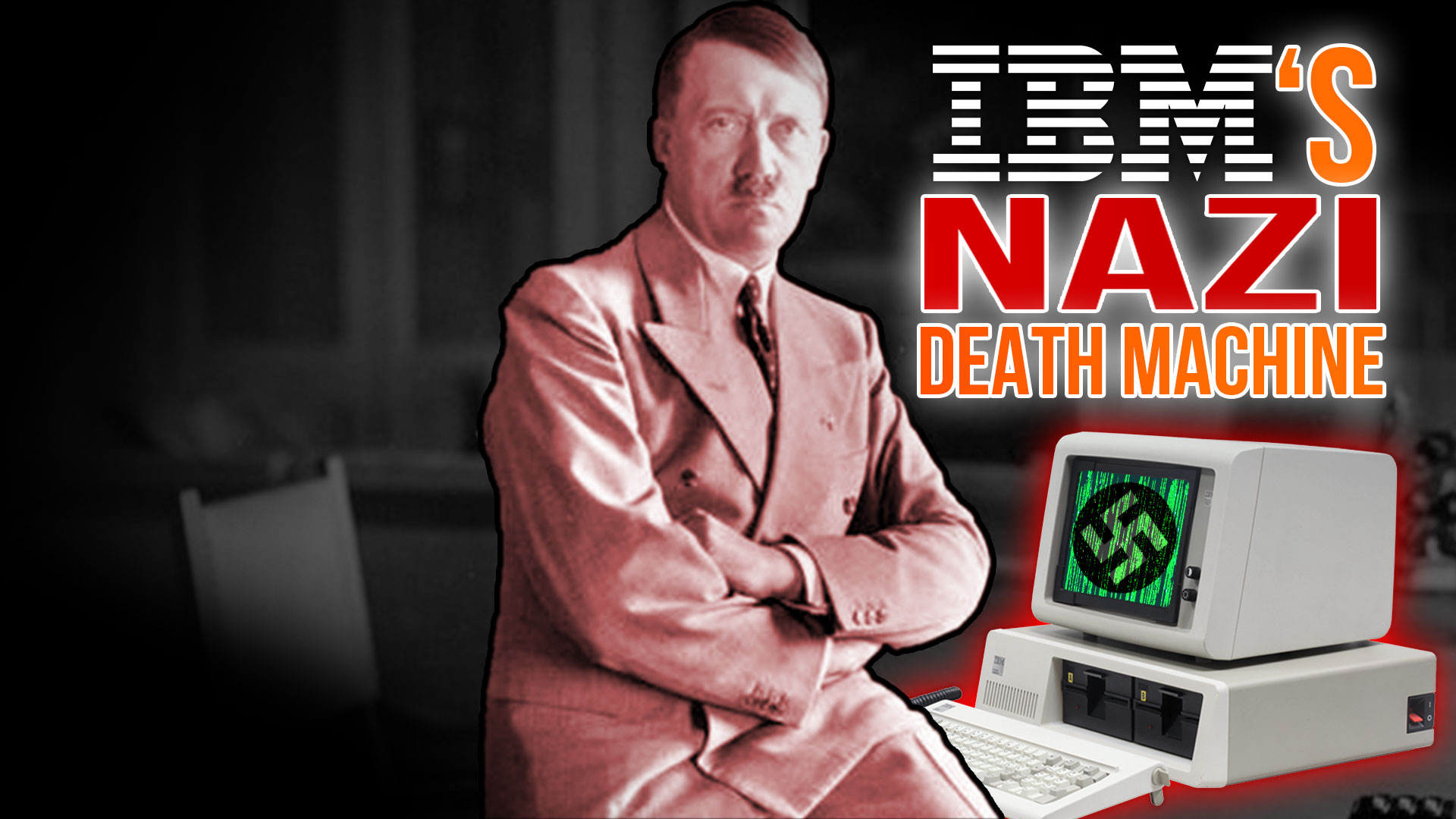
How the Nazis Teamed Up with IBM for Mass Murder, and the Incredible Story of the First Ethical Hacker

In the era of Big Data, few figures are more divisive as that of the hacker. On the one hand, malicious or “black hat” hackers cause billions of dollars of damage every year, breaking into private and public networks to steal money or personal data or simply to create chaos. On the other hand, so-called ethical or “white hat” hackers use their skills in service of the public good, either by probing computer systems for security weaknesses or leaking information on government corruption and other crimes. While mostly associated with the modern digital age, the art of hacking goes back nearly a hundred years. And one of the earliest hackers was also one of the most ethical, using his skills to save millions of French citizens from the Nazis during the Second World War. This is the remarkable story of René Carmille.

The era of Big Data is a lot older than you might think, tracing its origins back to the 1880s and a daunting problem facing the United States Government. The U.S. Constitution mandates that a census be taken every 10 years so that taxes and political representation can be updated according to the changing population. The first U.S. Census took place in 1790, and for the next 90 years census data was collected and processed entirely by hand. In 1880, however, the Census Bureau faced a major crisis: the U.S. population had grown so large that the 1880 census took a full 9 years to complete; by the time the data was ready to use, it was already time for the next census. At this rate, the Bureau feared, future censuses would never be able to catch up, rendering the whole exercise pointless.

Enter Herman Hollerith, an American engineer who had worked on the 1880 census. In 1889, Hollerith patented an ingenious system for speeding up the tabulating of census data, based on the technology of punched cards. While punched cards had previously been used to automate the weaving of complex textile patterns, Hollerith’s system was the first to apply them practically to the field of data processing. Hollerith was inspired by a system introduced by the railroads to help identify and catch train robbers and other criminals. As photography at the time was a slow, cumbersome process, train tickets were instead printed with a series of physical descriptors such as height, eye colour, and facial hair which the conductor could fill out using a standard ticket punch. In this manner, a rough description of each passenger could be recorded. Hollerith realized that this system could easily be adapted to the census, and designed his own punch cards to record census data and a piano-sized machine called a Tabulator to read and process it.

The Hollerith system worked as follows. Census takers would travel around the country and record data like the number, ages, and sex of the people in each household by punching holes in the corresponding fields on the Hollerith cards. These cards would then be sent back to the census bureau for processing. An operator would insert the cards into the Tabulator one by one through a hinged hatch rather like a modern flatbed scanner or photocopier. When the hatch was closed, a grid of spring-loaded metal pins was forced against the card. Where a hole had been punched the pin passed through and made contact with a pool of mercury, completing an electrical circuit. This data was counted and displayed on a series of clock-like dials on the face of the Tabulator, to be manually read and recorded by the operator. The genius of the Tabulator, however, lay in its ability to be rewired or “programmed” to count different combinations of data – for example, unmarried males under the age 30. Hollerith also invented a device called a Sorter consisting of 13 vertical metal bins with spring-loaded lids, each of which could be programmed to collect a different combination of data. So if, for example, the operator inserted a card which included an unmarried male under 30, the bin lid programmed with that combination would pop open so the operator could drop the card in.

The Hollerith system was adopted by the Census Bureau just in time for the 1890 census, and its impact was dramatic. The use of punched cards and tabulators cut the time required to process the census data from 9 down to two years. This dramatic improvement in efficiency lead to Hollerith machines becoming standard equipment at the Census Bureau, and in 1896 Hollerith founded the Hollerith Tabulating Machine Company to sell his machines commercially. Among his first clients were the Prudential Life Insurance Company and the New York Central Railroad, the latter of which processed nearly 4 million freight waybills every year and was an ideal fit for the Hollerith system. Over the next decade Hollerith introduced a number of key innovations which made his system increasingly more efficient and powerful, including redesigned punch cards, improved keypunches for filling out those cards, printers for automatically tabulating data, automatic card feeders and sorters, and plugboards to allow the tabulators to be reprogrammed without having to physically rewire the circuitry. These innovations created a brand-new industry, and Hollerith-style tabulators – now known as “unit record machines” – were adopted by a vast array of businesses for data-heavy tasks like processing invoices and payrolls. The Information Age had officially arrived.

But for Herman Hollerith, success was not to last. In 1903 the new director of the Census Bureau, Simon North, decided that Hollerith had too much of a monopoly on data processing and banned the company’s machines from the Bureau. Then, in 1911, through stock acquisition the Tabulating Machine Company was merged with four other companies to create the Computing-Tabulating Company. Finally, in 1923, this amalgamated company changed its name to International Business Machines – better known as IBM.

Under the direction of CEO Thomas Watson, IBM would go on to dominate the unit record and later the digital computer industry, controlling over 90% of all punch card equipment in the United States by 1950. One of the keys to IBM’s success was that they never sold their machines to clients; they only ever leased them. At one point IBM even considered charging its clients for every individual punch card they used, a practice which would have netted them even more obscene profits. However, for the United States Government this was a step too far, and in 1932 IBM was taken to court for violating the 1914 Clayton Antitrust Act. Though IBM argued that the cards – for which they held the patent – were technically a component of the machines they were already leasing to clients – in 1936 the Government ultimately ruled against them. While IBM was allowed to specify the design of the cards used in its machines, clients were free to acquire the cards themselves from any source they wanted – including manufacturing them themselves. However, even this attempt to extort clients over individual punch cards was far from the most unethical activity IBM would ever be involved in.

The outbreak of the Second World War saw a dramatic surge in business for IBM. Not only did millions of fighting men and tons of military equipment need to be processed for deployment overseas, but unit record equipment quickly found new applications in the field of cryptanalysis. IBM punch card equipment proved ideally suited to searching endless reams of enciphered enemy signals searching for the rare repeats that could help crack the cipher key – a tedious task that had previously been done entirely by hand. Dozens of IBM machines were used at Allied codebreaking centres like Bletchley Park in Buckinghamshire and Arlington Hall in Washington D.C, where they helped to penetrate enemy ciphers like the Nazi Germany’s Enigma and Imperial Japan’s “Purple” and shorten the war by an estimated two years.

But IBM equipment would also be put to far more sinister uses. Like dozens of American companies like Ford, General Motors, Chase Manhattan Bank, and Coca-Cola, IBM did not allow the outbreak of war to interfere with its international business dealings – even those with Nazi Germany. When the Nazis came to power in 1933, the new government put out a tender for a census of the German people. By this point the Nazis had already expelled all Jewish lawyers, doctors, scientists, and other professional from their jobs, and it was abundantly clear that the true goal of this census was to identify and persecute the remaining Jews and other undesirables in Germany. Indeed, in a public statement, Reinhard Koherr, a statistician working for the Nazi Government, sinisterly announced that: “…in using statistics the government now has the road map to switch from knowledge to deeds.”

Nonetheless, Thomas Watson, the CEO of IBM, instructed the company’s German subsidiary DEHOMAG to bid on the contract, which they ultimately won. Over the next decade, hundreds of IBM unit record machines along with spare parts and punch cards were shipped to Germany, where they were immediately put to use in organizing what would eventually become the Holocaust. Machines were set up in the headquarters of the SS’s Rassenamt or Race Office and even in concentration camps like Dachau, where millions of German Jews, Roma, Communists, Homosexuals and other groups deemed politically or racially inferior were systematically identified, categorized, and earmarked for arrest, imprisonment, deportation, forced labour, or extermination. Shockingly, IBM and its subsidiary did far more than simply provide the Nazis with equipment, also sending hundreds of technicians to Germany to train SS personnel how to use and maintain the temperamental equipment. These technicians also developed custom punch cards and special codes to help the SS designate and process concentration camps, prisoner types, and causes of death. For example, Auschwitz was 001, Buchenwald 002, Dachau 003, and so on; 3 designated a homosexual, 9 an anti-social, and 8 a Jew; while 3 represented death from natural causes, 4 summary execution, 5 death by suicide, and 6 by “special treatment” – the Nazi euphemism for extermination via gas chamber. Given this intimate involvement, it is highly unlikely that IBM was unaware of what its machines were being used for, yet the flow of equipment and personnel continued unabated. In fact, so instrumental was IBM to the Nazis’ policy of genocide that in 1937 Adolf Hitler awarded Thomas Watson the Order of the German Eagle for services to the Third Reich, an honour bestowed on several other American Nazi sympathizers including Henry Ford and Charles Lindbergh – and for more on the Lone Eagle’s relationship with the Nazis, please check out our sister channel’s, video “Lucky Lindy and Advancing Medical Science” on our channel Highlight History.

The outbreak of the Second World War in 1939 should have ended the company’s dealings with Nazi Germany, and indeed in June 1940 Thomas Watson returned his Order of the German Eagle. But while IBM publicly feigned remorse for its pre-war actions, in the background their collaboration with the Nazis carried on as before. In 1939 Watson authorized the shipment to Germany of special IBM alphabetizing machines, which were used to round up and execute millions of Jews, intellectuals, and other undesirables during the Nazi conquest of Poland. So complicit was Watson in this policy that he even bankrolled the construction of concrete bunkers at Dachau to protect its IBM machines from British air raids. The Nazi government also offered to buy DEHOMAG outright, giving IBM the opportunity to make a clean break from its subsidiary. But Watson refused, and DEHOMAG remained under the direct control of IBM headquarters in New York. In 1940, Watson directly managed the establishment of a Dutch subsidiary tasked with identifying and rounding that country’s Jews. Aided by the Netherland’s existing Hollerith machine infrastructure and a long Dutch tradition of recording religion in the national census, this effort succeeded in murdering 102,000 of the Netherland’s 140,000 Jews – an extermination rate of 73%. In every territory they conquered, the Nazis immediately carried out a census to identify and round up its racial and political enemies – a process made all the more efficient by IBM equipment. But when the Nazis rolled into France in June 1940, they finally met their match in an unassuming civil servant named René Carmille.

Born in 1886, Carmille served in the French Army during the First World War, first as an artillery commander and later in the military intelligence service. In 1924 he was appointed comptroller of the Army, in which role he oversaw the adoption of Hollerith Tabulating machines to improve the efficiency of Army logistics. After transferring to the Civil Service in the 1930s, Carmille established the National Demographic Statistical Office, which pioneered the use of IBM punch card machines in the tabulating of the French census. With war clouds looming, Carmille’s department undertook the creation of a national register of military-aged men fit for mobilization in the coming conflict. As part of this effort, Carmille invented the social security number, which he based on each person’s date and place of birth. This system of unique numbers, he realized, was less cumbersome and prone to accidental overlap than categorizing people by their first and last names, and is still used in France to this day.

Following the German invasion and partition of France, Carmille went to work for the collaborationist Vichy regime in the so-called “free zone” of southern France. But Carmille was no Nazi sympathizer. As a member of the French Resistance, Carmille made it his mission to sabotage the German administration of France in any way he could. His first order of business was to carry on with the creation of the national register. While presented to the Germans as merely a routine civil project, the real purpose of the registry was to secretly prepare the French Army for a sudden remobilization. During the winter of 1941-1942, Carmille identified the names of 220,000 demobilized soldiers living in the south of France, grouping them by unit and region. He also prepared a set of punched cards that would trigger the printing and distribution of mobilization orders across the country in a matter of hours.

However, Nazi racial policies soon began to interfere with this project. In 1941, Joseph Barthélémy, the Vichy Minister of Justice, instructed Carmille to identify Jewish citizens in his register. Fortunately France had a long tradition of secularism and had never recorded religion in any prior census, and Carmille argued – successfully – that given the civil nature of the project he was unable to comply. Thus the registry only recorded citizens’ date and place of birth, parents, marriages and divorces, children, date of death, nationality, current address, and sex. So massive was this project that for nearly two years Carmille was able to deny his department’s equipment and services to the Vichy police and the Gestapo, forcing them to rely on traditional paper-based methods for identifying and tracking down Jews. In 1942, however, the Nazis annexed the free zone and took control of all of France, forcing Carmille to abandon the national register and hide all evidence of the project in a Jesuit Seminary. Even worse, the National Demographic Statistical Office came under the direct control of the Nazis, who forced Carmille to conduct a new census aimed at identifying French Jews.

Unable to refuse directly, Carmille instead adopted a policy of passive resistance, seeking to obstruct and slow the data collection process as much as possible. He issued verbal rather than written instructions in order to delay responses and sow confusion, instructed his staff to mishandle punch cards, and he even hacked the IBM machines so they would never punch the 11th column indicating a citizen’s race or religion – rendering the whole exercise useless to the Nazis. Meanwhile, Carmille’s Resistance network sent agents to London with samples of the punch cards used by the Vichy regime, and used death notices received by the Statistical Service to create false identity cards for Resistance members and Jewish citizens. So effective was Carmille’s program of sabotage that by February 1944 the “Digital Report on the Number of French and Foreign Jews Counted in June 1941” was still not complete. By this time, however, the Germans had caught on to what Carmille was doing and arrested him in Lyon on February 3, 1944. After being tortured for two days by Gestapo officer Klaus Barbie, the infamous “Butcher of Lyon,” Carmille was sent by train to Dachau concentration camp, where he died of Typhus on January 25, 1945. While it can never be known how many French citizens Carmille’s sabotage saved, compared to the Netherlands’ extermination rate of 74%, only 25% of France’s Jews were murdered by the Nazis.

Despite collaborating with the Third Reich throughout all 12 years of the regime’s existence, either Thomas Watson nor IBM ever faced justice for their role in the Holocaust. In 2002, a group of five Romani Holocaust survivors filed a lawsuit against the company, but after two years of review the case was dismissed on account of the statute of limitations having run out. But the death and destruction wrought with the assistance of the tech giant could have been far worse, if not for men like René Carmille. In many ways René Carmille epitomizes the ethical hacker ethos of David versus Goliath; though neither a general or a soldier or a powerful politician, Carmille managed to use the limited technological power at his disposal to save millions of his fellow citizens during one of the darkest chapters in human history.

If you liked this article, you might also enjoy our new popular podcast, The BrainFood Show (iTunes, Spotify, Google Play Music, Feed), as well as:

Expand for References

Koski, Dustin, Top 10 American Companies that Aided the Nazis, TopTenz, January 2, 2015, https://www.toptenz.net/top-10-american-companies-that-aided-the-nazis.php

Black, Edwin, IBM’s Role in the Holocaust – What the Documents Reveal, HuffPost, February 27, 2012, https://ift.tt/SrZpsGU

The Korherr Report, July 16, 2005, http://www.deathcamps.org/reinhard/korherr.html

Beatty, Jack, Hitler’s Willing Business Partners, The Atlantic, April 2001, https://www.theatlantic.com/magazine/archive/2001/04/hitlers-willing-business-partners/303146/

Davis, Amanda, A History of Hacking, The Institute, March 6, 2015, https://web.archive.org/web/20150404142154/http://theinstitute.ieee.org/technology-focus/technology-history/a-history-of-hacking

Wills, Matthew, WWII and the First Ethical Hacker, JSTOR Daily, February 14, 2017, https://ift.tt/5KDXlBL

The post How the Nazis Teamed Up with IBM for Mass Murder, and the Incredible Story of the First Ethical Hacker appeared first on Today I Found Out.


from Today I Found Out
by Gilles Messier - May 05, 2022 at 02:56PM
Article provided by the producers of one of our Favorite YouTube Channels!
-

That Time a U.S. President Killed a Man in Cold Blood and Got Away With It Scot-Free

On May 30, 1806, Andrew Jackson dueled with famed marksman Charles Dickinson, killing him, after Dickinson insulted Jackson in a variety of ways including calling Jackson’s wife of bigamist.  This latter point was a sore spot for Jackson as his wife really had married him while she was still married to her former husband.  She had separated from her first husband, Captain Lewis Robards, in 1790 and subsequently moved in with Jackson and began calling herself his wife.  The two were soon officially married but this was later nullified by the fact that she and Captain Robards had never actually finalized their divorce, in terms of doing the paperwork, though the community itself considered them divorced.  She had to remarry Jackson in 1794 once the divorce with Captain Robards went through.

Both Dickinson’s father-in-law and Jackson at the time were horse breeders and rivals of one another. The beef between the two that eventually escalated to Jackson challenging Dickinson to a duel started in 1805 when Jackson had a $2000 (about $35,000 today) bet with Captain Joseph Erwin, Dickinson’s father-in-law, on a horse race.  The winner would get $2,000 from the other, or if the horse one or the other bet on couldn’t run, then that person would have to pay the other $800. Erwin’s horse did indeed not run the race, having come up lame, while Jackson’s horse Truxton did run, and so Erwin was forced to pay Jackson $800, though there was a disagreement between the two about which notes Jackson would be paid with.

Later Dickinson overheard a secondhand account of things Jackson supposedly said about Erwin over the matter and became angry at Jackson about it and fought with the person telling the story, who was a friend of Jackson.  Dickinson then sent Thomas Swann to ask Jackson whether what he heard was true, which Jackson denied, but in the process Jackson physically attacked Swann and said he was a “stupid meddler”.

Dickinson then wrote to Jackson, calling him a “coward and an equivocator”.  This escalated to the point where the two were sending a series of insults back and forth, including publishing some in the National Review, such as this last one which was the final straw, published in May of 1806 by Dickinson calling Jackson a “worthless scoundrel, … a poltroon and a coward” after Jackson had called Dickinson a “a worthless, drunken, blackguard”.

Despite the fact that Dickinson was known to be one of the best marksmen in all of Tennessee and dueling was illegal in that state, Jackson challenged him to a duel by sending him a note stating, he wanted “satisfaction due [him] for the insults offered.”   Because dueling was illegal in Tennessee, they traveled to Logan, Kentucky, and dueled on the shores of the Red River.

Jackson conceded the first shot to Dickinson, choosing not to fire when he turned, even though Dickinson was such a good marksmen.  He and his second thought there was a chance Dickinson might miss, having to turn and shoot and trying to do so as quickly as possible before Jackson could get off a shot.  So if he did miss or otherwise dealt a non-fatal blow, Jackson could then take his time and aim and kill him with the one shot he was allowed, as Dickinson would be required to stand still and give Jackson his chance.  Things didn’t go quite as smoothly as hoped, as the shot fired by Dickinson hit Jackson in the chest just a few inches from his heart, breaking two ribs in the process.

Not to be dissuaded, Jackson stayed on his feet and carefully aimed at Dickinson and pulled the trigger… only nothing happened as the hammer had stopped half-cocked.  So he re-cocked it and pulled the trigger again, this time hitting Dickinson in the chest.

A few hours later Dickinson died as Jackson’s shot had damaged an artery.  He was only 26 years old leaving his wife a widow, all over a silly “he said / she said” type argument pertaining to her father’s honor.  All things being equal, we imagine Captain Erwin would have rather his daughter still had her promising young husband around.

Whatever the case, Jackson lived on and eventually became President, although because of the bullet’s proximity to his heart, it could not be removed and remained in his chest for the remaining 39 years of his life, reportedly causing him quite a bit of pain.  Asked after the fact how he kept his feet after a near deadly hit to the chest, Jackson replied, “I should have hit him if he had shot me through the brain.”

This duel didn’t endear people to Jackson as many thought it was dishonorable for him to aim to kill after Dickinson had already taken his shot, thinking Jackson should have instead simply aimed to hurt Dickinson instead or even that he should have fired in the air to spare his life, thus ending the duel.

This was not the only time Jackson had a rather colorful interaction with another human who slighted him as we’ll get into shortly in the Bonus Fact on what happened after someone tried to assassinate President Jackson.

If you liked this article, you might also enjoy our new popular podcast, The BrainFood Show (iTunes, Spotify, Google Play Music, Feed), as well as:

Bonus Facts:

The first assassination of a President is both well-known and well-documented. On April 14, 1865, actor and southern advocate John Wilkes Booth shot the 16th U.S. President Abraham Lincoln at Ford’s theater. Lincoln died from his wounds not long after. (Incidentally, shortly before this, John Wilkes Booth’s brother saved Abraham Lincoln’s son’s life by grabbing him and pulling him back when Lincoln’s son was bumped and was subsequently about to fall into a moving train as a result.)

In any event, less well-known was the next assassination of a commander-in-chief. On July 2, 1881, 20th U.S. President James Garfield was assassinated by Charles J. Guiteau. He did live for 80 days after being shot, but developed a severe infection from the gunshots, with a contributing factor possibly being several doctors who stuck their unsterilized fingers in one of the bullet holes to try to find the bullet lodged deep in Garfield’s body. (Note: contrary to popular belief, much of the time, it’s better to leave the bullet in than try to remove it, even today- back then even more so.) His health gradually deteriorated until he finally suffered a heart attack and an aneurysm.

Garfield was nearly assassinated earlier, but Guiteau lost his nerve after seeing the President’s grief over his extremely ill wife. After Garfield’s wife recovered somewhat, Guiteau followed through with his plan and shot the President.

The next assassination of a U.S. President is also slightly less well-known. 25th President William McKinley was shot by anarchist Leon Czolgosz on September 6, 1901. McKinley died from an infection caused by the bullet wounds a week later, on September 14, 1901.

After McKinley had been shot twice, his immediate action was to save the life of the assassin who a mob had gathered around. He then asked for them to break the news gently to his wife. The two were extremely close and were almost never parted (particularly as she was epileptic and he liked to be around in case she had a seizure). On the way to his funeral, his wife was, to quote one contemporary account, “huddled in a compartment of the funeral train, praying that the Lord would take her with her Dearest Love.” After the funeral, she set up a shrine in their home and regularly visited McKinley’s burial vault. It was thought she wouldn’t last long after his death, but lived another 6 years before dying at 59.

On November 22, 1963, 35th president John F. Kennedy was shot in Dallas by Lee Harvey Oswald, perhaps a part of a conspiracy, perhaps not. He died shortly thereafter.

Although Lincoln’s assassination was the first, it was not the first Presidential assassination attempt.

This brings us back to the one and only Andrew Jackson. On January 30, 1835, Andrew Jackson, the 7th and perhaps the most colorful of all President was attending a funeral when his life was almost ended.

The would-be assassin was Richard Lawrence, a painter, who at the time of the assassination attempt believed himself to be King Richard III of England (in fact, Richard III, the last King of the House of York, died some 350 years before at the Battle of Bosworth Field, which is regarded by many historians as marking the end of the Middle Ages; this battle also is considered by many to have brought to a close the Wars of the Roses).

In any event, around the time of the assassination attempt, Lawrence found himself out of work, something he blamed President Jackson for, rather than his own insanity. He further thought that the U.S. government owed him a significant amount of money and if he could just kill Jackson, then it would be paid to him. He also felt that money would become plentiful in the U.S. as a result of Jackson’s death. Once he had his money, he planned to return to England where he would take back his throne, as King Richard III.

The actual assassination attempt took place after a funeral that Jackson attended, that of Warren R. Davis, a former Representative from South Carolina. When Jackson was leaving the funeral, Lawrence stepped out from behind a pillar he was hiding behind, pointed his Derringer at Jackson from around 13 feet away and pulled the trigger. Reports state the firearm went off, but the bullet did not leave the chamber. He then quickly discarded the first Derringer and drew out his second and pulled the trigger, this time with Jackson just a few feet away (rather than run away, or try to hide, which would have been contrary to Jackson’s nature, Jackson charged his would be assassin). This second shot reportedly went off like the first, with a loud bang, but with no bullet exiting the chamber.

Jackson didn’t take kindly to this assassination attempt and subsequently attacked Lawrence with a cane. Others around Jackson helped subdue Lawrence, including Congressman Davey Crocket, who incidentally was a staunch political enemy of Jackson, but nevertheless saw fit to help him take down Lawrence. Some reports even state that Jackson had to ultimately be pulled away from Lawrence as he continued to beat him even when Lawrence was down and subdued.

Lawrence was subsequently tried, though not convicted, by virtue of his insanity. He was then placed in a variety of asylums for the remainder of his life, dying 26 years later in 1861.

Conspiracy theorists at the time felt that Lawrence’s assassination attempt was actually not Lawrence’s idea, but was instigated by certain of Jackson’s political opponents, including Senator George Poindexter, who had hired Lawrence to paint his home just a few months before the attempt on Jackson’s life. Indeed, enough people thought Poindexter was involved in the assassination attempt that many of his own supporters withdrew their support and he was unable to get re-elected. Jackson himself thought Senator John C. Calhoun was the main person behind the attempt.

In any event, speaking of President Garfield, Due to being extremely poor thanks to his father’s untimely death when future President James Garfield was just 17 months old, Garfield worked a variety of odd jobs to help support himself during his education, including working as a janitor, a carpenter, and a bell ringer. Shortly after graduating from seminary, he took a position as a teacher and later sought higher education, attending Williams College. He then worked as a preacher, a principal of a high school, and a teacher of classical languages, before getting into law and then politics. Garfield was also extremely poor during his short Presidency thanks to the fact that the President was still expected to pay White House operating expenses out of his own salary (including funding expensive state dinners and the like; this was partially how Thomas Jefferson had accrued so much debt in his lifetime). As most Presidents were independently wealthy, this was not usually a problem. Garfield was not in any way wealthy, and even had to borrow a horse and buggy from former President Hayes to get around.

Going back to Jackson, he not only was the first known U.S. President someone tried to murder, but also is thought to be the first to be physically attacked while in office. The attacker was Robert B. Randolph and the attack happened about two years before the assassination attempt. Randolph had been in the Navy but Jackson had him dismissed. Randolph later attacked the President, striking him and then running away when people around Jackson attempted to grab him. Randolph ended up getting away with striking the President scot-free as Jackson didn’t press charges.

The post That Time a U.S. President Killed a Man in Cold Blood and Got Away With It Scot-Free appeared first on Today I Found Out.


from Today I Found Out
by Daven Hiskey - May 05, 2022 at 02:41PM
Article provided by the producers of one of our Favorite YouTube Channels!
-

Wednesday, May 4, 2022

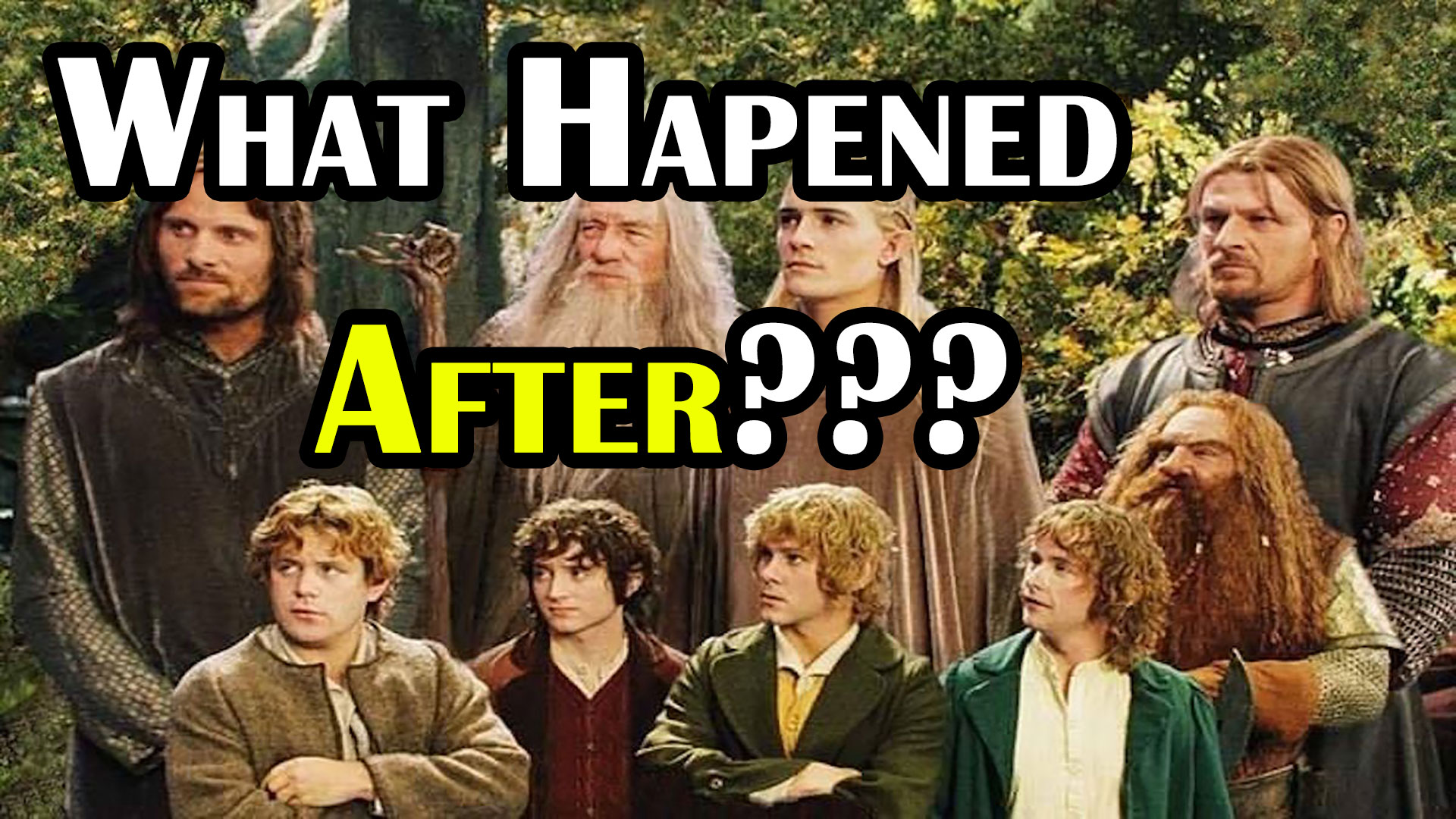
What Happened to the Members of the Fellowship of the Ring After The Lord of the Rings?

“Well, I’m back.”

Not including the six appendices, these are the last words of the final chapter of J.R.R. Tolkien’s The Lord of the Rings. They’re spoken by Sam Gamgee to his wife Rosie as he returns from seeing Frodo and the rest of the Ring-bearers depart from the Grey Havens into the True West. Implied, but not overtly stated, is that they “lived happily ever after,” all the days of their lives. But what did that happily ever after look like for the four hole-dwelling halflings and the other members of the Fellowship of the Ring? What happened to them all after The Lord of the Rings?

As for Samwise, Frodo’s final words proved exactly right in every respect. Prior to the hobbits’ road trip to the Grey Havens, Sam read the first page of the manuscript Frodo had been working on, and Bilbo before him, recounting the events of the Quest to Erebor and the War of the Ring as seen from the perspective of the five little folk, as well as translations of elvish tales dating back to the First Age. Frodo had titled it “The Downfall of the Lord of the Rings and the Return of the King.” Nicknamed the Redbook of Westmarch, a copy of this was Tolkien’s quote/unquote “source” for his fictions set in Middle-earth, from the familiar Lord of the Rings and The Hobbit to The Silmarillion and other obscure asides like Athrabeth Finrod ah Andreth.

Upon reading the title, Sam remarked that the book was just about finished, to which Frodo replied, “I have quite finished, Sam. The last pages are for you.” It was contributing to these final pages that Sam spent a significant portion of his later life, and his attestation forms the basis for how we have knowledge of the final fates of the Fellowship. In addition to passing along his unfinished tales, Frodo also told Sam during their final parting at the Havens, “Frodo-lad will come, and Rosie-lass, and Merry, and Goldilocks, and Pippin… You will be the Mayor, of course, as long as you want to be, and the most famous gardener in history.”

This too proved prescient, with Sam and his descendants taking the surname Gardner, making him quite literally the most famous in history. He named his next five children exactly as Frodo foresaw, though didn’t stop there; he and Rosie bred more like rabbits than hobbits, their large litter totaling thirteen kids.

Sam was elected the Mayor of the Shire in the sixth year of the Fourth Age, the first of seven consecutive seven year terms holding the office, a record rivalled only by the ten terms of Jerry Gergich of Pawnee, Indiana. During his tenure, one of the duties of Mayor became serving as an official counsellor to the king – a duty also shared in the Shire by the Thain and the Master of Buckland, offices filled in Sam’s day by former Fellowship members Peregrin Took and Meriadoc Brandybuck, respectively. Despite Frodo having taken the “last ship” into the West, Sam too was granted passage to the Undying Lands on account of him having briefly been a Ring-bearer between the time that the she-spider Shelob seemingly killed Frodo to the two hobbits’ reunification in the tower of Cirith Ungol. Thus, in the year 61 of the Fourth Age, Sam took the Straight Road to the Lonely Island, following his master quite literally to the ends of the earth.

Some two years later, Merry handed down his office of Master of Buckland to his son, and his close companion Pippin likewise passed the title of Thain to his heir, Faramir Took. Just a few years shy of a hundred and eleventy, the two trekked across the vastness of Eriador, repeating the same general sojourn from the Shire to Rohan to Gondor. While in Edoras, Merry – who during the war had served the Roharrim as the squire to King Théoden himself – spent time with Théoden’s nephew and successor, King Éomer, who himself passed away that autumn. From there the two progressed to Minas Tirith, where the noble knight sir Peregrin Took himself had served as a Guard of the Citadel. There they spent their final years, being buried alongside the Stewards and the Kings of Gondor.

As a King of Gondor himself, Aragorn too would eventually be interred in the tombs there, but not for several score more years. In 120 of the Fourth Age, on his two hundredth and tenth birthday, after a hundred and twenty-two year reign over the Reunited Kingdom as King Elessar, he decided to die. But he didn’t commit suicide or sepukku or anything. He simply possessed such unique strength of will among all mortal men that he was able to willingly sunder his spirit from his body and the world at the appointed hour. This is actually what also had happened to Bilbo, Frodo, and Sam, after their long retirement in the so-called Undying Lands. Per Tolkien:

“[It was] an opportunity for dying according to the original plan for the unfallen: they went to a state in which they could acquire greater knowledge and peace of mind, and being healed of all hurts both of mind and body, could at last surrender themselves: die of free will, and even of desire, in estel. A thing which Aragorn achieved without any such aid.”

That Aragorn achieved this is particularly fitting given that his childhood nickname while growing up in Rivendell was Estel, an elvish word meaning hope, particularly the kind of hope for a good outcome despite all evidence to the contrary other than a trust in God’s goodness. You see, unlike Elves, who knew they would continue to enjoy longevity and continual reincarnation for the duration of the solar system, nothing was promised to the Men of Middle-earth after they died: not heaven, or a resurrection, or respawning at the last checkpoint. Nothing. So Aragorn’s decision to die really was the ultimate trust fall, one which could possibly end in his utter annihilation and non-existence.

But not everyone was as hopeful as he was, particularly the wife he was willingly widowing, Queen Arwen. She alone was beside him at his deathbed, begging him to live longer and not leave her. But to the truly bitter end Aragorn remained every bit as steadfast in his strength of character as he had throughout the War of the Ring. His final words before dying reiterated that hope: “Let us not be overthrown at the final test, who of old renounced the Shadow and the Ring. In sorrow we must go, but not in despair. Behold! we are not bound forever to the circles of the world, and beyond them is more than  memory, Farwell!”

With that, the king was dead. Tolkien described it thusly: “Then a great beauty was revealed in him, so that all who after came there looked on him in wonder; for they saw that the grace of his youth, and the valour of his manhood, and the wisdom and majesty of his age were blended together. And long there he lay, an image of the Kings of Men in glory undimmed before the breaking of the world.”

Utterly bereaved, Arwen left Gondor and returned to her longtime home of Lothlórien, by then deserted and decaying, emptied of all its elven magic. There – upon what was once the hill where Galadriel and Celeborn had reigned over the land, and where Arwen and Aragorn had promised themselves to one another, she renouncing her immortality in doing so – there she laid down and died as a mortal woman. So that subplot in the movies where Elrond doesn’t want Aragorn hooking up with his daughter? This is the thing Elrond was worried about. Arwen could’ve been with her dad on the Lonely Island sunbathing and sipping daiquiris for a few more millenia, but instead, she actually for real died, something which simply does not happen to the other elves for as long as the world lasts.

Arwen was not the only close companion of Aragorn to take his passing particularly hard. The death of the king was the catalyst which convinced Legolas to finally leave Middle-earth. During the post-War years, Legolas and Gimli had travelled together for some time back to Fangorn Forest and the Glittering Caves behind Helm’s Deep. Legolas spent the majority of his last century establishing a colony of Silvan elves in Ithilien, the woodland region of Gondor between the Anduin river and the mountains or Mordor, which had been devastated during Sauron’s return. Under Legolas; leadership it “became once again the fairest country in all the westlands.”

Gimli likewise led a colony of his own, bringing Longbeard dwarves descended from Durin to the Glittering Caves. Unlike the stereotypical greedy mining and smithing of other dwarves like those of Moria and Erebor, Gimli’s folk were far more ecologically-minded, tending the jewel-encrusted columns of stalactites and stalagmites almost like a Japanese gardner gently trimming a bonsai tree. Nevertheless, they did produce enough mithril with which to forge new gates for Minas Tirith to replace those felled by the Witch-king.

Still, when Aragorn had died, Legolas at last heeded the call of the sea that had haunted his heart ever since first hearing the cry of gulls when he and Gimli had helped Aragorn capture the corsairs at Pelargir. He built a grey ship with which to sail over the Sea along the Straight Road to the Undying Lands, asking Gimli to join him, the only dwarf ever to enjoy that honor. And as it passed over the horizon, so too, over a century after the Nine Walker were all last together, finally ended the days of the Fellowship of the Ring in Middle-earth.

If you liked this article, you might also enjoy our new popular podcast, The BrainFood Show (iTunes, Spotify, Google Play Music, Feed), as well as:

Bonus Facts:

Canonically, the most recent event to take place in Tolkien’s Middle-earth is whatever the hell is happening right now. That’s because, contrary to the mistaken assumption of many readers, Middle-earth is not another planet, nor “a name of a never-never land without relation to the world we live in.” Tolkien described it rather as an imaginary period of time taking place in our real world. This should be evident to those who have read even as far as the Prologue of Lord of the Rings, wherein Tolkien places the Shire in the northwest of Earth’s eastern hemisphere, approximately where England is today, albeit in a distant past, such that the shape of the surrounding lands is no longer quite the same. As to how distant of a past, Tolkien estimated that the final fall of Sauron took place approximately six millenia prior to the present period, and opined that if he were to date known history along the same paradigm as his imaginary past, we would now be living sometime in the Sixth or Seventh Age.

Non-canonically, Tolkien did write a story that would have taken place at the end of the reign of King Eldarion, about one hundred years after the death of his father Aragorn. This would-be sequel to The Lord of the Rings was to be titled The New Shadow, and would have been a thriller detailing the discovery and dismantling of satanic orc-cults among the youths of Gondor. Despite making three manuscripts of the story over the years, Tolkien never eked out more than thirteen pages of the tale, and ultimately abandoned it as a tale not worth writing – though the aborted first chapter was later posthumously published by his son Christopher in Book Twelve of his History of Middle-earth.

And now for another bonus fact:

There may be one canonical event in the Legendarium which has yet to take place. Though it appears nowhere in the published Silmarillion (an editorial decision made by Christopher Tolkien), many of the manuscripts contained the Prophecy of Mandos concerning Dagor Dagorath, a Sindarin phrase meaning “The Battle of Battles.” Basically, Ragnarök meets Revelation. Per the prophecy:

“When the world is old and the Powers have grown weary, Morgoth, the Black Foe of the World, seeing that the guard sleepeth, shall come back through the Door of the Night out of the Timeless Void; and all shall be darkness, for the sun he will turn to black, and the moon will no longer shed his light… But the Host of Valinor shall descend upon him as a searing flame, white and terrible. Then shall the Last Battle be gathered on the fields of Valinor.”

And now for a final bonus fact:

The notion that the divine plan for Mankind, had it not Fallen under the Shadow of evil, was for all to die in the willing manner of Aragorn, is not necessarily gospel-truth within the fiction. Tolkien himself spent much of his later years meditating on the metaphysics of how his fiction function, with specific emphasis on the nature of Elves and Men.

Circa his writing of the trilogy, Tolkien’s perspective of mankind’s mortality within the fiction was that “…the mere shortness of human life-span – is not a punishment for the Fall, but a biologically (and therefore spiritually, since the body and spirit are integrated) inherent part of Man’s nature.” This he admitted at the time was “bad theology… but it is an imagination capable of elucidating truth, and a legitimate basis of legends.” Later in life, however, he labored to write new legends that could better conform to his Catholic worldview.

These were “The Debate of Finrod and Andreth” and the associated “Tale of Adanel.” During the debate the Elf Finrod dispels the misconstructions of the mortal woman Andreth, explaining that Elves are not truly immortal, but merely experience “serial longevity,” and no matter how many millennia of life they enjoy, it’s always haunted by the notion that death will truly take them in the end. For her part, Andreth corrects his misconception that humanity’s desire for immortality was born of jealousy for the elves, explaining that before the two races ever met, men had long told themselves the legend that they were originally created to outlive the sun and stars and material universe altogether, existing eternally “without any shadow of an end.” The Tale of Adanel details how Sauron’s master Morgoth seduced the first humans away from worship of God to himself instead, and God’s subsequent imposition of mortality upon mankind, contra their original design as immortals.

“The Debate” concludes with what is the most explicitly Catholic part of any of Tolkien’s Legendarium. Andreth alludes to the Old Hope that “…the One will himself enter into Arda, and heal Men and all the Marring from the beginning to the end.” In his own commentary on the text, Tolkien elaborated that Finrod concluded from the exchange that the original design for unfallen humans must have been to still live life on earth for a short duration relative to that of elves, but then for every man to experience bodily assumption outside of time and space in the manner of Mary, mother of Jesus.

The post What Happened to the Members of the Fellowship of the Ring After The Lord of the Rings? appeared first on Today I Found Out.


from Today I Found Out
by Matthew Theriault - May 04, 2022 at 08:51PM
Article provided by the producers of one of our Favorite YouTube Channels!
-
We Still Don’t Know How Bicycles Work

“It’s as easy as riding a bicycle” – so the old saying goes. And indeed in the wide world of transportation few vehicles are as mechanically elegant as the humble bicycle, which at its most basic consists of little more than a tubular frame, two wheels, a steerable fork, a seat, pedals, and a chain drive. This basic configuration has remained essentially unchanged for more than 130 years, so it’s safe to assume that scientists and engineers know everything there is to know about bicycle design, right? Well, no, actually, for beneath the bicycle’s supposedly simple exterior lies a profound scientific mystery. It’s a phenomenon many of us have witnessed firsthand: let a riderless bicycle coast and it will remain upright, resisting all efforts to topple it until it finally slows down and falls over. Yet incredibly, despite more than a century of research, we still don’t 100% understand why.

The first bicycle as we would recognize it today appeared in 1820 in the form of German inventor Karl Drais’s “dandy horse” or “Draisine.” Unlike a modern bicycle, the Draisine had no pedals and had to be propelled by kicking one’s feet rather like a modern scooter. Over the next 70 years the bicycle would evolve into a multitude of weird and wonderful forms, including the popular “penny farthing” of the 1870s and 1880s with its gigantic front wheel. But it was not until the 1890s that the modern “safety” bicycle, with wheels of equal size and a chain drive, finally emerged. This design would take the world by storm, bringing affordable transport to the masses and spawning a global industry worth nearly $50 billion today. And aside from relatively minor improvements in shape, materials, and gear technology, the basic design of the common bicycle has remained more or less unchanged for over a century, making it one of the all-time design classics.

Yet despite the mechanical elegance and success of the safety bicycle, very little science or mathematics went into its design, the configuration having been arrived at through trial and error. It was not until the turn of the century that mathematicians began to seriously investigate the mysterious physics behind the bicycle’s remarkable stability. The most comprehensive early analyses were conducted in 1899 by English mathematician Francis Whipple and in 1910 by German mathematicians Felix Klein and Fritz Noether, who, using rigid-body mechanics, determined that a bicycle’s stability was mostly due to gyroscopic precession. This is the tendency of rotating objects to remain rigidly fixed in space and resist changes in orientation, and is responsible, for example, for keeping spinning tops upright. Thus, according to Whipple, Klein, and Noether, the wheels on a bicycle act as large gyroscopes, their rotation keeping the vehicle upright.

This remained the accepted explanation for bicycle stability for nearly 6 decades, until in 1970 British science writer David Jones examined Klein and Noether’s analysis and discovered a number of mathematical errors that effectively cancelled out the effects of gyroscopic precession. Furthermore, the parameters of the analysis assumed that the bicycle was stationary, even though a stationary bike is demonstrably not stable. To prove his point, Jones built a bicycle with extra counter-rotating wheels that cancelled out the gyroscopic effects of the main wheels, and found that it was just as stable as a regular bicycle. Something else had to be responsible for the bicycle’s remarkable self-righting ability. Back in the 1860s, Scottish engineer William Rankine had observed that when a coasting bicycle begins to topple over, the front wheel automatically steers into the fall, righting the bicycle once more. Indeed, if a bicycle’s handlebars are tied off so that the fork can no longer steer, it immediately becomes unstable. Based on this counter-steering phenomenon, Jones proposed a new model for bicycle steering which he called “caster theory.”

Casters, such as those found on shopping carts, are wheels where the steering axis  and the ground contact point are not aligned, the distance between the two being known as the “trail.” This offset causes the caster to automatically align itself with the direction of travel, allowing all four wheels on a shopping cart to steer at once. Examining common bicycle designs, Jones realized that the standard 72-degree angle of the front fork placed the steering axis – the imaginary line extending along the fork into the ground – ahead of the wheel’s ground contact point, effectively turning it into a giant caster. From this Jones concluded that only bicycles with a positive trail could be stable, and that the caster effect was the sole mechanism responsible for the bicycle’s self-righting ability. And there he left the matter, even boasting in his memoir 30 years later that: “I am now hailed as the father of modern bicycle theory.”

But Jones was a little too quick to rest on his laurels, for soon another researcher would arrive and blow the mystery of bicycle stability wide open. In 1975, American engineer Jim Papadopoulos, working at Cornell University, began reviewing nearly a century’s worth of academic papers on bicycle theory, and was unimpressed by what he found. Like the original Klein and Noether analysis, the papers either made overly simplistic assumptions or mathematical errors, and very few referenced each other or built upon previous studies. After a year of work, Papadopoulos managed to combine all these disparate analyses into a single, unified set of equations, which immediately revealed that Jones was wrong: it was in fact possible to build a stable bicycle with a negative trail, provided the weight distribution was moved far forward. Together with fellow engineer Andy Ruina, Papadopoulos launched the Cornell Bicycle Research Project, with the goal of better understanding bicycle dynamics and passing on that understanding to industry so that better, more efficient bicycles could be produced.

Based on Papadopoulos’ calculations, the team built an experimental device that barely resembled a bicycle, with small wheels and counter-rotating wheels to cancel out the gyroscopic effect, a negative trail to counter the caster effect, and a long weighted boom extending ahead of the front wheels. Amazingly, this strange contraption proved perfectly stable, demonstrating that neither gyroscopic precession nor the caster effect were solely responsible for the counter-steering phenomenon. Further research with a model featuring a small front and large rear wheel suggested a possible alternate explanation: when the bicycle begins to fall, the front end, being shorter, falls over faster than the rear end. However, as the two ends are rigidly connected, the front end pulls the rear with it, causing the fork to immediately steer into the fall and right the vehicle.

Despite this great leap forward, the Cornell Bicycle Research Project was short-lived. Not only had it failed to attract sponsorship from more than a handful of small bicycle companies, but Papadoupolos was slow to publish their findings, later admitting:

“I find much more joy discovering the new and working out the details and, of course, it’s boring to write it up.” (A sentiment that we here at TodayIFoundOut completely concur with :-))

In any event, with few published papers to show for their work, the project dissolved and Papadopoulos drifted away from bicycle research, moving to Illinois where he ended  up as an engineer for a toilet paper manufacturing company.

In 2001 David Wilson, an engineer at MIT and the inventor of the recumbent bicycle, invited Papadopoulos to co-author the third edition of the book Bicycling Science. But beset by a divorce, large debts, and other personal responsibilities, Papadopoulos took a full two years longer than anticipated to complete the work – much to Wilson’s frustration.

Meanwhile Andy Ruina continued to carry the torch of bicycle research, teaming up with fellow scientist Arend Schwab in 2001 to establish a bicycle research centre in – where else? – the Netherlands. In 2003 Papadopoulos joined the team, and together with J.D.G. Kooijman and J.P. Maijaard from the University of Delft, he, Ruina, and Schwab confirmed their results from the 1970s while carrying their research forward into a new, more high-tech domain – for example by building a cycling robot that could keep a bicycle upright through steering alone, without any weight shifting or stabilizing gyroscopes. This research culminated in a groundbreaking 2011 paper titled Bicycles Can Be Self-Stable Without Gyroscopic or Castor Effects.

The Delft research centre has also produced a variety of unconventional bicycle designs such as a stable rear-wheel-steering bike, a rear-wheel drive recumbent, a steer-by-wire bike that decouples the act of steering from that of balancing, and a powered steer-assist bike that automatically stabilizes itself at slow speeds. While these odd creations may seem like mere mechanical novelties, Ruina sees in them great potential to benefit the world, given the millions of people who depend on bicycles for daily transport:

“With these changes of appearance, one might have bicycles that are easier for old people to ride, bicycles that are easier to maneuver but still feel stable when riding straight, bicycles that have a more comfortable sitting arrangement, or bicycles that have more convenient places for storage or carrying kids.”

But while the Delft team sees endless possibilities for evolution in bicycle design, the bicycle industry has been slow to adopt their findings. Part of this reluctance is practical: despite being born of trial and error, the classic bicycle design is simple, robust, and just plain works. But another factor is organizational: the UCI, the international governing body for cycling sports, has standardized the design of road race bikes along traditional lines, forcing industry to conform to its guidelines. But Arend Schwab is optimistic, stating in a TEDx talk that:

“My vision is that with careful experiments and validated computer models, we can move past this 19th century bicycle evolution, into a 21st-century bicycle revolution.”

And despite the great strides made by the Delft team and other researchers, much about the dynamics of bicycle stability remains a poorly understood, a mystery both frustrating and exciting for researchers such as Mont Hubbard at UC Davis:

“Everybody knows how to ride a bike, but nobody knows how we ride bikes. The study of bicycles is interesting from a purely intellectual point of view, but it also has practical implications because of their ability to get people around

We are all stuck in the nineteenth century, when there wasn’t such a difference between math and physics and engineering. Bicycles are a math problem that happens to relate to something you can see.”

If nothing else, the fact that the bicycle still manages to stump the world’s leading mathematicians and engineers 130 years after its invention is a humbling lesson in how little we still know about the workings of the universe – a lesson perhaps best expressed by quantum physicist Michael Brooks in 2013:

 “Forget mysterious dark matter and the inexplicable accelerating expansion of the universe; the bicycle represents a far more embarrassing hole in the accomplishments of physics.”

If you liked this article, you might also enjoy our new popular podcast, The BrainFood Show (iTunes, Spotify, Google Play Music, Feed), as well as:

Expand for References

Sorrel, Charlie, The Bicycle is Still a Scientific Mystery: Here’s Why, Fast Company, August 1, 2016, https://www.fastcompany.com/3062239/the-bicycle-is-still-a-scientific-mystery-heres-why

Borrell, Brendan, The Bicycle Problem that Nearly Broke Mathematics, Nature, July 20, 2016, https://www.scientificamerican.com/article/the-bicycle-problem-that-nearly-broke-mathematics/

Kachur, Torah, Science of Cycling Still Largely Mysterious, CBC News, July 28, 2016, https://www.cbc.ca/news/technology/science-of-cycling-still-mysterious-1.3699012

Cartwright, Jon, How to Keep a Riderless Bike from Crashing, Science, April 14, 2011, https://www.sciencemag.org/news/2011/04/how-keep-riderless-bike-crashing

Busca, Nick, Your Bike’s Secret to Staying Upright is Actually a Mystery, Bike Radar, October 19, 2016, https://www.bikeradar.com/features/your-bikes-secret-to-staying-upright-is-actually-a-mystery/

The post We Still Don’t Know How Bicycles Work appeared first on Today I Found Out.


from Today I Found Out
by Gilles Messier - May 04, 2022 at 08:40PM
Article provided by the producers of one of our Favorite YouTube Channels!
-

What is the Record for Most Languages Spoken By One Person?

If you speak one language, you’re a normal, functioning human being. If you speak two, you’re bilingual. If you speak three, you’re an overachiever and everyone hates you. But what about if you speak 10? Or 20? Or 30? Well, then you’re considered a polyglot or a hyperpolyglot depending on how awesome a word you think you deserve to describe your mastery of the spoken word. (Though if we’re being really technical, while colloquially these two terms are often used pretty interchangeable, a polyglot is usually used to describe someone who speaks more than 6 languages whereas a hyper-polyglot is used to describe someone who speaks over 12. And if you’re wondering, the term polyglot is Greek in origin, coming from the Greek, polyglōttos, roughly translating to “many tongued”, which is probably a killer inclusion in a pick-up line if you’re such an advanced linguist.)

Now you’d think that discovering the person who spoke the most languages would be as simple as searching for it on the Guinness World Records site or a quick Google search, but alas, even the almighty Guinness and Google don’t know the answer to this question, which is perhaps why Patron Kyle posed the question to us in the first place.

So why is this such a difficult question to answer? The problem seems to lie in the fact that the definition of what it takes to be able to “speak” a language varies greatly. Is a person who can hold basic conversation in 100 languages more impressive than a person who has mastered reading and writing in 30? Is being able to speak in 10 different regional dialects the same as being able to speak 10 different languages? How different would those dialects need to be for the distinction to be made?  If someone becomes fluent in over 200 languages in their lifetime, but at any given time can only speak fluently a couple dozen worthy of the crown vs their compatriot who learned and maintained fluency in just 50?

It’s questions like these that make it very unlikely that we’ll ever truly know the identity of the most gifted polyglot in history, but we have a fairly good idea of a handful of people who should at least be considered for the crown

In terms of living people, a candidate for the record holder is Ziad Fazah, who reportedly speaks around 60 languages, though the exact number isn’t clear. That said, in one television appearance, Ziad was stumped by basic questions in several languages he’d previously claimed to be fluent in. That’s not to detract from the fact that Ziad has proven he’s able to speak a pretty ridiculous number of languages and he may have studied and once been fluent in the languages he was stumped in, and simply forgotten them; but it throws into question his claim of being able to currently speak 60 or more languages at this very moment.

A more verifiable living polyglot is one Alexander Arguelles, who has a proven working understanding of around 50. Again, the number isn’t clear, even in interviews, Alexander very rarely puts a hard figure on the number of languages he can speak and understand, stating only that “Now, I can read about three dozen languages and speak most of them fluently, and I’ve studied many more“.

In Alexander’s case, he puts his amazing gift for language down to thousands of hours of study and work. A sentiment that is echoed by other living hyper-polyglots, for example, Timothy Donner, who speaks over 20 different languages. In his case, though, he’s still in his mid-20s, so he has the potential to speak and understand as many, if not more languages than Alexander some day and perhaps become the greatest of all time. It should be noted that Timothy also refuses to bother learning so-called “easy” languages like Spanish, in lieu of learning more difficult ones like Urdu, Russian, Arabic, Hebrew, Yiddish, etc.

Looking historically, in the book, Babel No More: The Search for the World’s Most Extraordinary Language Learners, the 18th and 19th century Cardinal Giuseppe Caspar Mezzofanti is perhaps one of the most accomplished historic polyglots, reportedly being able to speak or understand 72 languages. Again, no one is sure of the exact figures, however. Regardless, Cardinal Mezzofanti’s skills with language were legendary in his time. The reason for the vast difference in the number of languages Mezzofanti was reported to have spoken stems from the fact he spoke many different dialects, which some scholars argue were so different in nature that they should technically count as entirely separate languages, while others aren’t willing to give him the credit. Even discounting his dialects, Mezzofanti was known to be able to speak Turkish, Arabic, German, Chinese, Russian and around two dozen other languages with, to quote the book, “rare excellence”. Considering he lived in 19th century, the fact he even came into contact with this many languages and found adequate books on the subjects to study, let alone learned to speak the languages fluently enough to converse with people in them, is hugely impressive.

A slightly more recent example of a hyper-polyglot is 19th century born Emil Krebs, who spoke a reported 65 different languages. Fun fact, Krebs took great enjoyment in the fact that he could translate the phrase “kiss my ass” into 40 different languages. When told that it’d be impossible to learn every language on Earth, Krebs asked which language would be the hardest to learn and mastered the hell out of that on principle.  If you’re curious, the language Krebs eventually settled on as the hardest was Chinese. Krebs affinity for language was so great that when he died in 1930, his brain was sent off for scientific study where it presumably exploded into a cloud of foreign expletives the second a researcher cut into it.

Yet another of one of the world’s top polygots was child prodigy William James Sidis who was a child whose famed psychologist father and doctor mother (one of the few women in the world in the 19th century to hold such a medical degree) used as a bit of a guinea pig to prove his father’s methods of more or less creating a child prodigy from scratch. To help facilitate this, his mother actually quit her medical practice and more or less trained the child with her husband from day 1, including the couple successfully teaching the child the English alphabet by a few months old, and to start speaking in under six months.

His parents were proud of their son, but possibly more proud that his father, Boris’s, techniques in teaching his son were genuinely working, constantly publishing academic papers showing off their successes. By two years old, William was reading the New York Times and tapping out letters on a typewriter from his high-chair – in both English and French. He wrote one such letter to Macy’s, inquiring about toys.

Unfortunately, his time to act like a child had already passed young William by. Studying seven different languages (French, German, Latin, Hebrew, Greek, Russian, and one he made up himself – Vendergood) and learning a high school curriculum at seven left Billy precious little time to act his age. His parents wanted the whole world to know about their prodigal son, as well as their participation in all of it.

He was accepted into Harvard at age nine, but the university refused to allow him to attend due to him being “emotionally immature.” His parents took this perceived slight to the media and William was front page news in the New York Times.  This gave William the notoriety and fame he was not prepared for. Tufts College, though, did admit him and he spent his time correcting mistakes in math books and attempting to find errors in Einstein’s theory of relativity.

His parents pressed Harvard further and when William turned eleven, they relented. William Sidis became a student at one of the most prestigious universities on Earth at the age most kids were perfectly content playing stick ball and not worrying about giving a dissertation on the fourth dimension.

Not hyperbole, on a freezing Boston January evening in 1910, hundreds gathered to hear the boy genius William Sidis in his first public speaking engagement, a talk about fourth dimensional bodies. His speech, and the fact that it was over most of the audiences’ heads, became national news.

Reporters followed William everywhere on campus. He rarely had a private moment. He graduated from Harvard at the age of 16, cum laude. Despite his success, Harvard was not a happy experience for young Billy.  According to Sidis biographer Amy Wallace, William once admitted to college students nearly double his age that he had never kissed a girl. He was teased and humiliated for his honesty. At his graduation, he told the gathered reporters that, “I want to live the perfect life. The only way to live the perfect life is to live it in seclusion. I have always hated crowds.”

After leaving Harvard, society and his parents expected great things from William. He briefly studied and taught mathematics at what later would become known as Rice University in Houston, Texas. His fame and the fact that he was younger than every student he taught made it difficult on him. He resigned and moved back to Boston.

He attempted to get a law degree at Harvard, but he soon withdrew from the program. William, brilliant as he was, struggled with his own self-identity. In May 1919, he was arrested for being a ringleader of an anti-draft, communistic-leaning demonstration. He was put in jail and that’s where he would meet the only woman he would love – an Irish socialist named Martha Foley. Their relationship was rather complicated, mostly due to William’s own declaration of love, art, and sex as agents of an “imperfect life.”

When in court, he announced that he didn’t believe in God, that he admired a socialist form of government, and many of the world’s troubles could be traced back to capitalism.  He was sentenced to eighteen months in prison.

Fortunately for him, his parents’ influence kept him out prison, but William decided he’d had enough of “crowds” and wanted his “perfect life.” He moved city to city, job to job, always changing his name to keep from being discovered. During this time, it’s believed he wrote dozens of books under pseudonyms (none of which were particularly well read), including a twelve hundred  page work on America’s history and a book entitled “Notes on the Collection of Streetcar Transfers,” an extremely in-depth look at his hobby of collecting streetcar transfers. It was described by one biographer as the “most boring book ever written.”

And just for fun, we’re going to read a small excerpt for a taste… Please don’t click away:

“Stedman transfers: This classification refers to a peculiar type turned out by a certain transfer printer in Rochester, N. Y. The peculiarities of the typical Stedman transfer are the tabular time limit occupying the entire right-hand end of the transfer (see Diagram in Section 47) and the row-and-column combination of receiving route (or other receiving conditions) with the half-day that we have already discussed in detail.”

We’re pretty sure Sidis’ real intent with this book was to once and for all cure insomnia, just the fact that this was his intent went over the rest of us mere mortal’s heads.

In any event, seclusion fit William just fine. He wanted nothing more than him and his genius to be left alone.

In 1924, no longer talking to his parents and out of contact with anyone who truly cared for him, the press caught up to William. A series of articles were printed describing the mundane jobs and the measly living conditions the supposed-genius William Sidis had. Ashamed and distressed, he withdrew further into the shadows. But the public remained infatuated with the former boy wonder’s apparently wasted talents.  In 1937, The New Yorker printed an article titled “April Fool!” which described William’s fall from grace in humiliating detail.

The story resulted from a female reporter who had been sent to befriend William. In it, it described William as “childlike” and recounted a story about how he wept at work when given too much to do. Sidis sued the New Yorker for libel and the case went all the way to the Supreme Court, before they eventually settled seven years later. But the damage had been done. William Sidis, for all the potential he showed as a child prodigy, would never become the man he was supposed to be.

On a summer day in July 1944, William’s landlady found him unconscious in his small Boston apartment. He had had a massive stroke, his amazing brain dying on the inside. He never regained consciousness and was pronounced dead at the age of 46 with a picture of the now-married Martha Foley in his wallet.

So how many languages did he speak? During his life, he became fluent in about 40 languages, though how many he remained fluent in at a given point isn’t clear.

Moving on from the sad tale of Sidis, perhaps the greatest number of languages claimed to be spoken by a single person is over 100. Yes, 100, with two zeroes. This claim was made by one, Sir John Bowring, the 4th governor of Hong Kong. In his life, Bowring was reportedly familiar with 200 languages, and was supposedly able to commune with others in over 100 of them. However, other than the fact that he and others close to him claimed he could speak this many languages, little else has ever been recorded about how proficient he was in any of them at a given point in time. Although, seeing as he lived his entire life as an obsessive student of language and given what his compatriots said of him, it is at least generally accepted he was likely one of the world’s most successful polygots. If claims are true, maybe even the most accomplished in history.

If you liked this article, you might also enjoy our new popular podcast, The BrainFood Show (iTunes, Spotify, Google Play Music, Feed), as well as:

Bonus Fact:

Languages obviously need not include the spoken word, with various sign languages being perhaps the first thing people think about when hearing that statement. But it turns out there exists languages entirely made up of whistles.  Perhaps the most talked about one is Silbo Gomero- a whistling language “spoken” on La Gomera in the Canary Islands (which incidentally may have been named after dogs, and certainly wasn’t named after birds as you might have expected from the name Canary Islands).

The language was used by the Guanches—the aboriginal people of the Canary Islands—long before Spanish settlement. It is a whistled form of the original Guanche language, which died out around the 17th century. Not much is known about that spoken language of those people save for a few words recorded in the journals of travellers and a few others that were integrated into the Spanish spoken on the Canary Islands. It is believed that spoken Guanche had a simple phonetic pattern that made it easily adaptable to whistling. The language was whistled across the Canary Islands, popular on Gran Canaria, Tenerife, and El Hiero as well as La Gomera.

It’s likely that the first Guanches were from North Africa and brought the idea of a whistled language with them, as there are several different whistling languages that have been recorded there.  From the time of Guanche settlement, the language evolved into Guanche whistling, and then to silbo.

Today, silbo is a whistled form of Spanish. It was adopted in the 16th century after the last of the Guanches adapted their whistled language to Spanish. The language works by replicating timbre variations in speech. One study showed that silbo is recognized in the “language center” of the brain by silbo whistlers, though regular Spanish speakers who were not silbo whistlers simply recognized it as whistling.

As to why such a version of a language would originally be developed at all, it’s thought that silbo was developed as a form of long distance communication. The island of La Gomera is awash with hills, valleys, and ravines. A whistle can travel up to two miles across such a landscape, and the whistler doesn’t have to expend as much energy as he would by hiking or shouting and, in the latter case, the whistled message is heard further away besides. When La Gomera was largely an agricultural island, crops and herds of animals like sheep would be spread out across the hills, and herders would use the language to communicate with one another across these large distances.

Speaking via whistling still saw widespread use as late as the 1940s and 50s. Unfortunately, economic hardship around the 1950s put silbo-speaking in the decline, as most of the whistlers were forced to move to find better opportunities. The introduction of roads and the invention of the mobile phone also contributed to the decline, as they made silbo largely unnecessary. By the end of the twentieth century, the whistled language was dying out.

However, as it is an integral part of the island’s history, there was interest in reviving the language to preserve the culture and today every primary school child on La Gomera is required to learn the whistling language.

The post What is the Record for Most Languages Spoken By One Person? appeared first on Today I Found Out.


from Today I Found Out
by Karl Smallwood - May 04, 2022 at 08:05PM
Article provided by the producers of one of our Favorite YouTube Channels!
-

Friday, April 29, 2022

Review: Trader Joe's Bamba Puffed Peanut & Corn Snacks with Hazelnut Crème Filling


The original Trader Joe's Bamba seemed quite identical to the Osem Bamba, but this one promised to be quite different, with a hazelnut filling at the center of the peanut-flavored corn puffs. ...

from Taquitos.net Snack Reviews
by April 29, 2022 at 06:43PM

Thursday, April 28, 2022

Review: Turtle Chips Sweet Bean Flavor


These snacks had the same odd shapes as the other Turtle Chips, but with a much lighter color than the cinnamon and choco churro ones and a slightly lighter color than the original flavor, with various shades of light beige, probably lightened by a bean powder. ...

from Taquitos.net Snack Reviews
by April 28, 2022 at 09:55AM

Wednesday, April 20, 2022

Review: Cheez-It Snap'd Barbecue


This snack looked much like the White Cheddar Bacon, Jalapeño Jack and Double Cheese versions of Cheez-It Snap'd, bringing a different shape, like a parallelogram, and crispier crunch than the regular Cheez-Its. ...

from Taquitos.net Snack Reviews
by April 20, 2022 at 06:05PM

Sunday, April 17, 2022

A Crisis of Minds- The Fascinating Tail of Fixing People By Destroying Their Brain

In November 1941, Rosemary Kennedy, the eldest sister of future American president John F. Kennedy, was admitted to the George Washington University School of Medicine to undergo a radical procedure. The then 23-year-old Rosemary had for many years exhibited erratic behaviour, mood swings, and mild learning difficulties that left her high profile parents exasperated and publicly embarrassed, until her father, Joseph P. Kennedy Sr, finally decided to do something about it. But the Rosemary that came out of the hospital was not the same Rosemary that went in. Her mental capacity had been reduced to that of a 2-year-old. Once vivacious and exceptionally charming, she could no longer speak coherent sentences and had become incontinent. Horrified, her parents locked her away in an institution and did not speak of her or her condition for nearly two decades. Rosemary Kennedy had been subjected to one of the psychiatry’s most infamous treatments: the lobotomy. For more than three decades, this crude form of psychosurgery was the go-to method for treating a wide variety of mental illnesses, from depression to schizophrenia, with nearly 40,000 being performed in the United States alone. But it was a horrifically imprecise and dangerous method, which far from curing patients occasionally left them totally incapacitated or even dead. But who invented the lobotomy, and how did such a life-shattering procedure come to be so widely accepted by the medical community and endure for as long as it did despite the occasionally horrific side effects?

In the early 20th Century the field of psychiatry was in crisis. While advances in neurology and the new practice of psychoanalysis had begun to shed some light on the origins of mental illness, the discipline was no closer to finding cures than in the days of bloodletting and ice baths. As their colleagues in other medical fields surged ahead with new discoveries like germ theory, surgical anaesthesia, and antibiotics, psychiatrists remained little more than caretakers, presiding over crowded asylums with few ways of actually treating their patients. Thus, any new breakthrough that promised to change this was met with great enthusiasm- too much in some cases. It is in this climate of desperation that procedures like insulin shock – and later electroshock – therapy emerged – and for more on this please check out our video “Who Invented Shock Therapy and How Does It Work?” But some saw such methods as too indirect, and wondered whether mental illness couldn’t be treated at its source, by cutting directly into the brain.

The first systematic study of psychosurgery was conducted by Swiss psychiatrist Gottlieb Buckhardt at the Préfargier Asylum in 1888. Like many psychiatrists at the time, Buckhardt believed that individual mental processes were localized in discrete areas of the brain, and that by selectively damaging or removing these areas a patient could be relieved of certain of their symptoms. His results were mixed, to say the least. Of six patients operated on, two remained unchanged, two became quieter, one experienced mild improvement, and one experienced violent epileptic seizures and died shortly after the operation. From there, many of the survivors experienced severe side effects including epilepsy and aphasia – the inability to understand or speak words. Other doctors were horrified by these experiments, and Buckhardt’s work was widely condemned. Thus while sporadic attempts at psychosurgery were made over the following decades by surgeons such as Ludvig Puusepp and Vladimir Bekhterev, it would not be until 1935 that the practice would become mainstream.

In that year, Portuguese neurologist António Egas Moniz developed the leucotomy, a procedure which involved drilling holes ineither side of the skull and making a series of incisions to sever the frontal lobes from the rest of the brain. The frontal lobes had long been suspected to be the seat of personality and behavioural regulation, a fact drastically illustrated by the infamous case of Phineas Gage. On September 13, 1848, Gage, an American railroad labourer, was packing gunpowder into a blasting hole near Cavendish, Vermont, using a metre-long tapered metal rod known as a tamping iron. The metal accidentally struck the rock, creating a spark that ignited the gunpowder and launched the tamping iron directly at Gage’s face. The iron entered Gage’s head just below his left cheek and exited through his left temple, landing some 25 metres away. Amazingly, Gage was not even knocked unconscious, and was able to speak coherently and sit upright as he was transported by oxcart to the local doctor. Over the next seven months Gage made a near-complete physical recovery and regained all his mental faculties, though he was no longer the man he once was. Previously described as a pleasant and genial man, following the accident Gage became, in the words of Harvard Professor H.J. Bigelow, “…gross, profane, coarse, and vulgar, to such a degree that his society was intolerable to decent people.” Indeed his closest friends declared “Gage… was no longer Gage.” While more recent studies have revealed that these personality changes were largely temporary – indeed, following the accident Gage had a long and successful career as a long-distance stagecoach driver in Chile – the case did much to convince psychiatrists of the central role of the frontal lobes in controlling personality and behaviour. This idea was further supported by cases of WWI soldiers who received wounds to the frontal lobes, and patients with large tumours in the same region. An even more dramatic illustration of the principle was an experiment conducted by Yale neuroscientist John Fulton. In the early 1930s Fulton performed frontal lobectomies on a pair of chimpanzees, Beck and Lucy, who exhibited aggressive behavioural tendencies. The results were astonishing, with both animals becoming remarkably placid and cooperative. When Fulton presented his results in 1935 at the Second International Congress of Neurology in London, Egas Moniz, who was in attendance, asked whether the procedure could be applied to humans. Stunned, Fulton responded that while it was theoretically possible, the procedure was “too formidable” an intervention to use on humans.

Moniz was nonetheless inspired, and in November of that year carried out the first leucotomies on psychiatric patients at the Hospital Santa Marta in Lisbon. At first Moniz used targeted injections of ethanol to kill nerve fibres and form a barrier of dead tissue behind the frontal lobes, but soon developed a wire-loop instrument called a “leucotome” which when rotated carved out a 1-centimetre spherical section of brain matter. These initial surgeries were performed on twenty patients suffering from a variety of disorders including depression, mania, schizophrenia, and catatonia, and according to his later report the results were promising, with 35% of patients experiencing significant improvement, 35% mild improvement, and 30% no change. However, “improvement” in this case appears to be a relative term, as the patients experienced a variety of severe side effects including extreme lethargy, confusion, and incontinence, and few were ever actually discharged from the hospital. But as none had died or suffered observable cognitive impairment, Moniz considered the experiment a success and published his findings in 1936. As with Buckhardt before him, Moniz’s work initially received a hostile reception from the medical community, with many decrying the procedure as unnecessarily reckless. But by this time the demand for a method – any method – to pacify patients and alleviate overcrowding in asylums had become so great that leucotomy was gradually adopted throughout the world. In 1949, Egas Moniz was awarded the Nobel Prize in Physiology and Medicine for his discovery.

But the heyday of the lobotomy would not come until the 1940s, thanks to one of the most controversial figures in American medicine: Walter Freeman. Born on November 14, 1895, Freeman met Egas Moniz at the same 1935 conference where John Fulton had presented his chimpanzee study, and was instantly taken in by the great neurologist’s genius. It was to prove a fateful encounter. Though he had long pondered the possibilities of psychosurgery, Freeman later claimed that had he not met Moniz in person he would likely never have pursued the subject, informing Moniz  “…having your authority I expect to go ahead.” On his return to the United States, Freeman and his colleague neurosurgeon James W. Watts set out to perfect Moniz’s method, performing the first American leucotomy on September 14, 1936 at George Washington University. Their patient was a 63-year-old Mrs. Hammatt from Topeka, Kansas, who was brought in by her husband suffering from agitated depression and insomnia. According to Freeman’s account, the surgery was a great success:

“She survived five years, according to Mr. Hammatt the happiest years of her life,” Freeman noted in his autobiography. “As she expressed it, she could go to the theatre and really enjoy the play without thinking what her back hair looked like or whether her shoes pinched.”

Encouraged by these results, Freeman and Watts set up a private practice  in D.C. and together performed nearly 1000 leucotomies between 1936 and 1945. But while the “Freeman-Watts” method, which involved drilling six small burr holes across the patient’s skull, was less invasive and more precise than Moniz’s original procedure, to Freeman it was still too elaborate. Freeman had worked at St. Elizabeth’s State Hospital in Washington D.C, and knew from first-hand experience that such institutions were often overcrowded and underfunded and rarely had operating rooms, anaesthesia, or surgeons available. Freeman thus set out to develop a procedure that could be quickly and easily performed on an outpatient basis by non-surgical staff.

Freeman found his answer in the obscure work of Italian psychiatrist Amarro Fiamberti, who in 1937 developed a procedure called the transorbital lobotomy in which the brain is accessed through the thin bones of the eye socket. Practicing on grapefruits and then cadavers, in 1945 Freeman adapted and refined Fiamberti’s method. Many of these early experiments were carried out using an ordinary ice pick from Freeman’s kitchen, hence the common name “ice-pick lobotomy” for the procedure.

In Freeman’s version of the transorbital lobotomy, the patient was rendered temporarily unconscious through the use of an electroconvulsive therapy or electroshock machine. Their eyelid was lifted and a long, thin instrument known as an orbitoclast placed between the top of the eyeball and the eye socket. A mallet was then be used to punch the orbitoclast through the thin orbital bone and into the brain. Once the instrument had been driven in around 5 centimetres, it was swept side-to-side, making a 40-degree incision and severing the frontal lobe. The procedure was then be repeated on the other eye socket. Beginning to end, the procedure took no more than 10 minutes to complete.

Freeman carried out his first transorbital lobotomy on January 17, 1946, and soon threw himself into evangelizing the procedure. Driving a van he dubbed “the lobotomobile,” he travelled thousands of miles to more than 55 hospitals across the country to demonstrate and promote his new procedure. A natural showman, Freeman would often show off by performing two lobotomies at once, or using his old kitchen ice pick instead of a proper orbitoclast. He had a reckless disregard for medical procedure, often chewing gum while operating and rarely wearing gloves or washing his hands. On one occasion he even invited the media to watch a procedure which ended in death when Freeman’s hand slipped and plunged the orbitoclast too deeply into the patient’s brain. This cavalier behaviour disgusted his colleague James Watts, causing the two to part ways in 1947. But the psychiatric community was impressed, and the use of lobotomies soared; between 1945 and 1949 the number of lobotomies performed annually in the United States grew from 150 to nearly 5000. The procedure was especially popular in the United Kingdom, where over 50,000 were performed. Lobotomies were prescribed for all manner of psychiatric conditions, however mild, and performed on patients of all ages. Freeman’s youngest-ever patient was 12-year-old Howard Dully of San Jose, California, who underwent the procedure on December 16, 1960. Freeman’s notes describe Dully’s behaviour as follows:

“He is clever at stealing, but always leaves something behind to show what he’s done. If it’s a banana, he throws the peel at the window; if it’s a candy bar, he leaves the wrapper around some place… he does a good deal of daydreaming and when asked about it he says, “I don’t know.” He is defiant at times – “You tell me to do this and I’ll do that.” He has a vicious expression on his face some of the time.”

Though diagnosed by Freeman as Schizophrenic, Dully’s behavioural problems were mild and typical of a boy his age, and today would likely be attributed to the sustained abuse he suffered at the hands of his stepmother. Incredibly, though he suffered from mental confusion and drug addiction, spent years in and out of institutions and halfway houses, Dully eventually made a near-complete recovery and suffers few lingering effects from the surgery.

Most others, however, were not so lucky. Though Freeman claimed a success rate of around 50%, many lobotomy patients were reduced to a vegetative or child-like state, unable to care for themselves and requiring life-long institutionalization. Those who retained their faculties often exhibited a “flattening” or “blunting” of affect, becoming passive and apathetic, while others suffered from seizures or other neurological side effects. A lucky few like Howard Dully experienced no change at all. The greatest benefit of the procedure was often not to the patient themselves but their families and hospital staff, as it made patients more docile and easier to handle. As Freeman enthusiastically reported:

“The noise level of the ward went down, ‘incidents’ were fewer, cooperation improved, and the ward could be brightened when curtains and flowerpots were no longer in danger of being used as weapons.”

Disturbingly, the use of lobotomy as a means of social control went even deeper. In all countries where it was adopted, the procedure was performed disproportionately on women, echoing the 19th Century practice of diagnosing difficult or disobedient women with the catch-all disorder of “hysteria.”

But the days of the lobotomy were numbered. By the mid-1950s the vast numbers of patients left permanently disabled by the procedure could no longer be ignored by the medical community, and the use of lobotomy began to taper off, with several countries such as Germany, Japan, and the Soviet Union banning it altogether. The introduction of antipsychotic drugs like Thorazine also made such radical surgical interventions increasingly unnecessary, and sparked the mass de-institutionalization of psychiatric patients that Freeman had long dreamed of. But Freeman remained stubbornly devoted to his procedure, and after moving to California in 1954 continued to perform lobotomies both in state hospitals and his own private practice. In 1967, Freeman operated on Helen Mortensen, who had been lobotomized twice before but whose symptoms continued to relapse. During the procedure Freeman accidentally severed a blood vessel in Mortensen’s brain, leading to her death three days later. Herrick Memorial Hospital, where the surgery was performed, revoked Freeman’s surgical privileges; he never performed another lobotomy. Walter Freeman died of cancer on May 31, 1972 at the age of 76, having personally lobotomized 3,439 patients.

The golden age of the lobotomy was brief but tragic. Though the use of the procedure had largely ended by the late 1960s, it continued to be performed in countries such as France well into the 1980s – but only as a last resort when all other interventions had failed. All told, more than 40,000 people were lobotomized in the United States alone, with 490 dying and countless others being permanently disabled. Though born of good intentions and the desire to free the mentally ill from overcrowded hospitals, the lobotomy became the embodiment of social control, institutional abuse, and medical hubris whose dark legacy still haunts the field of psychiatry to this day. Though many experimental psychosurgical techniques have been developed in recent years to treat disorders such as Parkinson’s disease, obsessive-compulsive disorder, and epilepsy, the looming shadow of Walter Freeman and his cavalier methods has discouraged many researchers from pursuing this line of research – and government institutions from funding it.  As Bart Nuttin, a researcher at the Catholic University in Leuven, Belgium, explains:

“I definitely believe that there is a very important public stigma attached to surgical treatments for psychiatric disorders, and that this is for good reasons. I am convinced that in the past this kind of surgery has been abused. My greatest fear is that some surgeons would start using [new techniques] in a less controlled way than we have. There remains a need for strict official control of this kind of treatment.”

Similarly, according to University of Michigan neuro-psychologist Elliot S. Valenstein:

“I think they’re really concerned about the reaction to the [perceived] notion that the government is supporting brain operations and that there may be a resurgence of lobotomies in this country.”

As for Howard Dully, who suffered so much at the hands of Walter Freeman, his opinion of the controversial doctor is remarkably magnanimous:

“I don’t think Freeman was evil. I think he was misguided. He tried to do what he thought was right, then he just couldn’t give it up. That was the problem.”

If you like this article, you might also enjoy:

Expand for References

Gordon, Meryl, “‘Rosemary: the Hidden Kennedy Daughter’, by Kate Clifford Lawson”, The New York Times, October 6, 2015, https://ift.tt/d4v9xHV

Nicholas, Elizabeth, Rosemary Kennedy and the Legacy of Mental Illness, VICE, October 5, 2015, https://ift.tt/GHJsAqt

Walter Freeman: the Father of Lobotomy, Medical Bag, May 21, 2015, https://ift.tt/HBfKMrh

He Was Bad, so They Put an Ice Pick in His Brain, The Guardian, https://ift.tt/W3PKgme

El-Hai, Jack, The Lobotomist, The Washington Post, February 4, 2001, https://ift.tt/Nnx6wUa

Tan, Siang Yong & Yip, Angela, António Egas Moniz (1874–1955): Lobotomy pioneer and Nobel laureate, Singapore Medical Journal, April 2014, https://ift.tt/CAHtNMp


The post A Crisis of Minds- The Fascinating Tail of Fixing People By Destroying Their Brain appeared first on Today I Found Out.


from Today I Found Out
by Gilles Messier - April 17, 2022 at 01:57AM
Article provided by the producers of one of our Favorite YouTube Channels!
-

Saturday, April 16, 2022

Tuesday, April 12, 2022

Friday, April 1, 2022

Review: Betty Crocker Dunkaroos


This snack tray had two compartments, one holding 17 small, round cookies with a "D" on top of each, and the other, a tub of chocolate dip. ...

from Taquitos.net Snack Reviews
by April 01, 2022 at 04:15PM

Sunday, March 20, 2022

Review: Cadbury Flake


This is another case where we've already reviewed some of the brand extensions of a snack — specifically Flake Dipped and Flake Snow -- and compared them to the original, yet we never actually did a review of the original. ...

from Taquitos.net Snack Reviews
by March 20, 2022 at 06:30PM

Saturday, March 19, 2022

Review: Nutter Butter Cakesters


We first encountered Cakesters in Oreo form, as they created a snack cake that generally looked like an Oreo cookie, at a somewhat larger scale. ...

from Taquitos.net Snack Reviews
by March 19, 2022 at 09:38PM

Review: Doritos Stax Mexican Chilli Salsa


This snack was first time we've seen the Stax and Doritos brands combined on the same product, bringing the canned package style and uniform shapes of Stax to the familiar corn-based Doritos chips. ...

from Taquitos.net Snack Reviews
by March 19, 2022 at 02:47PM

Review: Ballreich's A Touch of Salt Sweet Potato Chips


This snack surprised us in a few ways. ...

from Taquitos.net Snack Reviews
by March 19, 2022 at 10:59AM

Friday, February 25, 2022

Arizona Fruit Snacks


Fruit snacks are candy. You know it, I know it. Kids might not think so. They're wrong.

from Candy Gurus
by Matty February 25, 2022 at 08:00AM

Wednesday, February 16, 2022

Review: Rap Snacks Icon Notorious B.I.G. Cookout BBQ Sauce


These potato chips had gently curving shapes and a light orange color generally, with lots of powder of various colors scattered around the surfaces, including some dark specks. ...

from Taquitos.net Snack Reviews
by February 16, 2022 at 05:36AM

Monday, February 7, 2022

Review: Cheez-It Puff'd Double Cheese


These snacks were labeled as Cheez-Its, and they had the square shapes and center indentations of Cheez-Its, but really they were pretty much not Cheez-Its at all, but rather Cheez-It-themed cheese puffs. ...

from Taquitos.net Snack Reviews
by February 07, 2022 at 12:24PM